
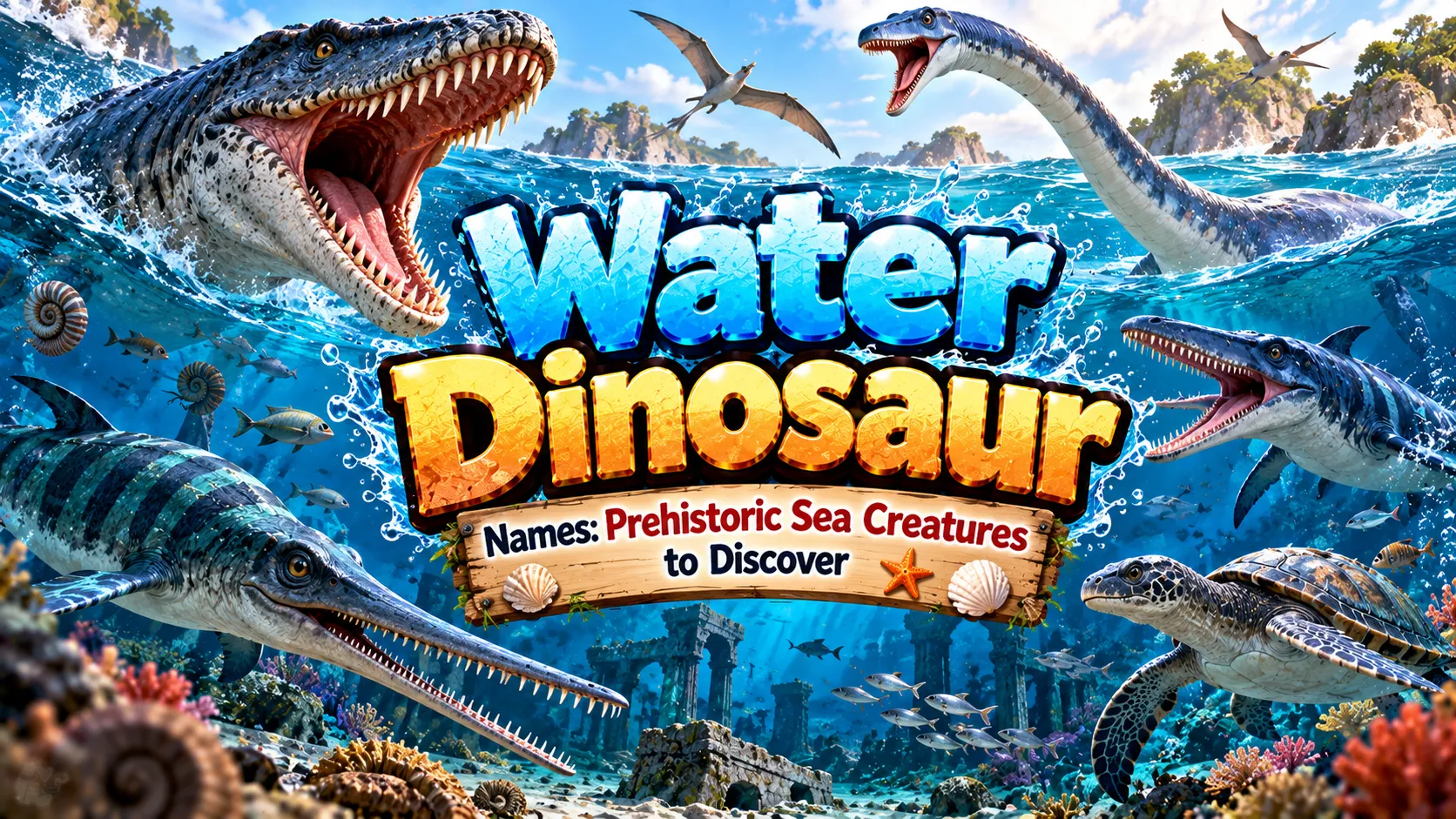
Looking for water dinosaur names that sound powerful, mysterious, and unforgettable? The prehistoric oceans were home to incredible creatures with enormous jaws, streamlined bodies, long necks, and paddle-like flippers. From the fearsome Mosasaurus to the elegant Plesiosaurus, these ancient animals have captured the imagination of dinosaur fans for generations.
Although people commonly call them water dinosaurs, most famous prehistoric ocean predators were actually marine reptiles rather than true dinosaurs. They lived during the Mesozoic Era, when dinosaurs dominated the land and remarkable reptiles hunted in ancient seas. Some, such as Ichthyosaurus, resembled modern dolphins, while others, including Pliosaurus, had massive heads and powerful jaws.
In this guide, you’ll discover famous aquatic prehistoric animals, their meanings, distinctive features, dinosaur names associated with water, and creative ocean-inspired names for toys, games, and fictional creatures. Whether you’re researching prehistoric animals or looking for an unforgettable name, these fascinating creatures offer plenty of inspiration.
🌊 What Are Water Dinosaurs Called?
Water dinosaurs is a popular term for prehistoric animals that lived in or around water. However, most well-known creatures described this way were marine reptiles, not members of the dinosaur group.
During the Mesozoic Era, which lasted from approximately 252 to 66 million years ago, several groups of marine reptiles evolved to thrive in oceans and coastal waters. Their adaptations included powerful tails, streamlined bodies, specialized teeth, and limbs modified into flippers.
Here are some of the best-known prehistoric marine animals:
- Mosasaurus — A large marine reptile with powerful jaws and a long tail.
- Plesiosaurus — A marine reptile with a long neck and four flippers.
- Ichthyosaurus — A streamlined reptile with a fishlike body.
- Pliosaurus — A short-necked marine reptile with a large head.
- Elasmosaurus — A long-necked plesiosaur.
- Tylosaurus — A large mosasaur with an elongated snout.
- Kronosaurus — A powerful pliosaur with strong jaws.
- Shonisaurus — A giant ichthyosaur from the Triassic Period.
Understanding this distinction makes it easier to explore prehistoric sea creatures accurately while still enjoying the familiar term water dinosaurs.
🦈 Famous Water Dinosaur Names and Their Meanings
Some prehistoric marine reptile names sound almost mythical, but each belongs to a real animal known from fossil evidence. Their names often describe physical characteristics, geographical discoveries, or similarities to other animals.
| Prehistoric Animal | Name Meaning or Association | Distinctive Feature |
|---|---|---|
| Mosasaurus | Lizard of the Meuse River | Powerful jaws and long tail |
| Plesiosaurus | Near lizard | Long neck and four flippers |
| Ichthyosaurus | Fish lizard | Fishlike body |
| Pliosaurus | More lizard | Large head and short neck |
| Elasmosaurus | Thin-plate lizard | Extremely long neck |
| Tylosaurus | Knob lizard | Elongated snout |
| Kronosaurus | Named after Kronos in Greek mythology | Powerful marine predator |
| Liopleurodon | Smooth-sided tooth | Large pliosaur with a broad skull |
| Ophthalmosaurus | Eye lizard | Large eyes |
| Nothosaurus | False lizard | Semiaquatic or coastal adaptations |
| Thalassomedon | Sea ruler | Long-necked marine reptile |
| Shonisaurus | Named after the Shoshone Mountains region | Large ichthyosaur |
| Prognathodon | Forward-jaw tooth | Robust jaws |
| Archelon | Ruler turtle | Giant extinct marine turtle |
| Tanystropheus | Long vertebra | Remarkably elongated neck |
These animals belonged to different reptile groups. Some were active predators, while others had different diets and ecological roles. Their names provide a useful starting point for learning about ancient marine ecosystems.
🔴 Mosasaurus: The Powerful Prehistoric Ocean Predator
Mosasaurus is one of the most recognizable animals in lists of water dinosaur names. It lived during the Late Cretaceous Period and was adapted to life in marine environments.
Its long body, paddle-shaped limbs, powerful tail, and strong jaws helped it move through the water and capture prey. Mosasaurus belonged to the mosasaur group, which was related to modern lizards and snakes rather than true dinosaurs.
The name Mosasaurus refers to the Meuse River region, where important early fossils were discovered. Several species of mosasaurs existed, and their sizes varied considerably.
Quick facts about Mosasaurus:
- Group: Marine squamate reptiles
- Period: Late Cretaceous
- Habitat: Ancient marine environments
- Features: Long tail, flippers, and powerful jaws
- Name association: Lizard of the Meuse River
Mosasaurus is a popular choice for dinosaur-themed toys, educational projects, fantasy stories, and games because of its impressive appearance and reputation as a marine predator.
🔵 Plesiosaurus: The Long-Necked Marine Reptile
Plesiosaurus is famous for its long neck, small head, broad body, and four paddle-like flippers. It lived during the Jurassic Period and is often featured in illustrations of prehistoric oceans.
The animal used its flippers for movement through water. Its unusual proportions make it easy to distinguish from short-necked marine reptiles such as Pliosaurus.
The name Plesiosaurus is commonly interpreted as near lizard. Although it is frequently called a water dinosaur, it was a marine reptile from a different evolutionary group.
Quick facts about Plesiosaurus:
- Group: Plesiosaurs
- Period: Early Jurassic
- Habitat: Marine environments
- Features: Long neck and four flippers
- Best-known characteristic: Distinctive body proportions
Plesiosaurus is a great example of how diverse prehistoric ocean animals could be. Not every marine reptile evolved the same body shape or hunting strategy.
🐬 Ichthyosaurus: The Dolphin-Like Prehistoric Reptile
Ichthyosaurus had a streamlined body, flippers, large eyes, and a powerful tail. Its appearance was so fishlike that it is easy to mistake it for a modern marine animal at first glance.
The name means fish lizard, reflecting its body shape. However, Ichthyosaurus was a reptile, not a fish or dinosaur.
Its streamlined form was well suited to swimming, and its large eyes are one of its most recognizable features. Ichthyosaurs formed a diverse group of marine reptiles that lived during much of the Mesozoic Era.
Quick facts about Ichthyosaurus:
- Group: Ichthyosaurs
- Period: Early Jurassic for the genus Ichthyosaurus
- Habitat: Marine environments
- Features: Streamlined body and large eyes
- Name meaning: Fish lizard
For anyone exploring prehistoric ocean animal names, Ichthyosaurus stands out because it resembles dolphins and other modern swimming animals.
🟣 Pliosaurus and Kronosaurus: Powerful Marine Hunters
Pliosaurus and Kronosaurus were large marine reptiles known for their robust heads and powerful jaws. Both belonged to the pliosaur group, a branch of plesiosaurs with shorter necks than their long-necked relatives.
Pliosaurus had a large skull, strong teeth, and a body adapted for swimming. Kronosaurus was another formidable marine predator, named after Kronos, a figure from Greek mythology.
Their fossils help scientists understand the variety of predators that inhabited prehistoric seas. However, size estimates and comparisons depend on the particular species and the completeness of fossil remains.
Quick facts:
- Pliosaurus: A large-headed, short-necked marine reptile.
- Kronosaurus: A powerful pliosaur with a robust skull.
- Shared group: Pliosaurs, which were marine reptiles.
- Main adaptations: Swimming limbs, strong jaws, and predatory features.
These animals are often popular with fans who want prehistoric creature names that sound strong and intimidating.
🐊 Tylosaurus and Other Mosasaur Names
Mosasaur diversity extended beyond Mosasaurus. Different genera developed distinctive skull shapes, body proportions, and teeth that suited their ecological roles.
- Tylosaurus — A large mosasaur with an elongated snout.
- Prognathodon — A mosasaur with robust jaws.
- Platecarpus — A more lightly built mosasaur.
- Clidastes — A relatively slender mosasaur.
- Globidens — A mosasaur known for rounded teeth associated with crushing hard-shelled prey.
- Hainosaurus — A large mosasaur genus.
- Mosasaurus — The best-known member of the group in popular culture.
Mosasaur names are useful search terms for anyone interested in marine reptiles, Cretaceous ocean predators, or prehistoric sea animal comparisons.
🌿 Dinosaurs That Had Connections to Water
Not every prehistoric animal associated with water was a marine reptile. Some actual dinosaurs lived near rivers, wetlands, or coastlines and possessed adaptations linked to catching fish or finding food in aquatic environments.
Spinosaurus
Spinosaurus was a large theropod dinosaur with a long snout, conical teeth, and a distinctive sail-like structure on its back. Fossils indicate a strong association with aquatic environments, and many researchers consider it one of the most water-adapted known non-avian dinosaurs. The exact details of its swimming abilities and behavior remain debated.
Baryonyx
Baryonyx was a spinosaurid dinosaur with a long snout, conical teeth, and a large claw. Its anatomy and fossil evidence suggest that fish were an important part of its diet.
Suchomimus
Suchomimus was another spinosaurid with a long, narrow snout and teeth suited to catching slippery prey. Its anatomy suggests an association with river and wetland environments.
Irritator
Irritator was a spinosaurid dinosaur known from fossils discovered in Brazil. Its skull anatomy is consistent with the fish-eating adaptations found in related dinosaurs.
These dinosaurs are especially relevant if you’re searching for dinosaur names connected with water rather than strictly marine reptile names.
🐢 Other Prehistoric Aquatic Animals Worth Knowing
Prehistoric waterways contained more than marine reptiles. Ancient turtles, amphibians, fish, and other aquatic animals also occupied rivers, lakes, coastal areas, and oceans.
- Archelon — An enormous extinct marine turtle.
- Styxosaurus — A long-necked plesiosaur.
- Dolichorhynchops — A relatively short-necked plesiosaur.
- Polycotylus — Another short-necked plesiosaur.
- Nothosaurus — A reptile associated with shallow marine environments.
- Tanystropheus — A long-necked reptile associated with coastal habitats.
- Megalodon — An extinct giant shark, not a dinosaur or marine reptile.
- Dunkleosteus — An armored prehistoric fish.
- Sarcosuchus — A giant extinct crocodile relative.
- Deinosuchus — A giant crocodilian relative.
These animals lived at different times and in different environments. Some coexisted with dinosaurs, while others lived much earlier or belonged to lineages that continued evolving after the age of non-avian dinosaurs.
🎮 Creative Water Dinosaur Names for Toys, Games, and Stories
If you are naming a toy, fictional sea monster, game character, or imaginary aquatic dinosaur, you may prefer a short name that sounds memorable and matches its personality.
Cool Water Dinosaur Names
- Aqua
- Neptune
- Triton
- Reef
- Tide
- Storm
- Bluefin
- Ocean
- Current
- Lagoon
- Deepwave
- Seaquake
- Wavecrest
- Frostfin
- Hydro
- Abyss
- Tempest
- Coral
- Skipper
- Splash
Cute Water Dinosaur Names
- Bubbles
- Splashy
- Pebble
- Shelly
- Finley
- Dottie
- Bluebell
- Puddle
- Wavy
- Sunny
- Nemo
- Coco
- Pebbles
- Squishy
- Tiny Tide
- Little Reef
- Bloop
- Seafoam
- Pippin
- Ocean Bean
Powerful Sea Monster Names
- Abyssfang
- Stormjaw
- Deepclaw
- Tidebreaker
- Shadowfin
- Leviathan
- Thunderwake
- Ironwave
- Darkcurrent
- Ocean Titan
- Reefcrusher
- Wavehunter
- Frostjaw
- Seastorm
- Tempest King
- Blackwater
- Kraken
- Deepstrike
- Abyss King
- Tidal Fury
These are invented or borrowed mythological-style names, not scientifically recognized prehistoric animal genera. They work well when you want a name that conveys power, speed, mystery, or a playful aquatic personality.
📚 How to Choose the Best Water Dinosaur Name
The best name depends on whether you want scientific accuracy, a memorable character name, or an idea for a school assignment.
- For scientific research: Choose a recognized genus such as Mosasaurus, Ichthyosaurus, or Plesiosaurus, and verify the spelling and classification.
- For a dinosaur toy: Short names such as Aqua, Splash, Reef, and Finley are easy for children to remember.
- For a powerful fictional creature: Names such as Stormjaw, Abyssfang, and Tidebreaker create a dramatic impression.
- For an educational project: Include the animal’s group, geological period, habitat, and one distinctive adaptation. This helps distinguish a marine reptile from a true dinosaur.
- For a story or game: Match the name to the creature’s personality. A gentle, long-necked animal might suit a name like Lagoon, while a powerful predator might suit Stormjaw.
A useful rule is to separate scientific animal names from creative names. That way, you can enjoy imaginative naming ideas without accidentally presenting fictional names as real prehistoric species.
❓ Frequently Asked Questions About Water Dinosaur Names
What are the most famous water dinosaur names?
Mosasaurus, Plesiosaurus, Ichthyosaurus, Pliosaurus, Elasmosaurus, Tylosaurus, and Kronosaurus are among the most famous prehistoric marine reptile names. They are commonly called water dinosaurs in popular culture, but they were not true dinosaurs.
What was the biggest water dinosaur?
There was no recognized group of true water dinosaurs comparable to marine reptiles. Several marine reptiles reached enormous sizes, including large ichthyosaurs, pliosaurs, and mosasaurs. Identifying the single largest depends on the species, fossil evidence, and whether scientists compare length or body mass.
Was Mosasaurus a dinosaur?
No. Mosasaurus was a marine squamate reptile related to modern lizards and snakes. It lived during the Late Cretaceous Period and was adapted to life in the ocean.
Which dinosaur was most adapted to water?
Spinosaurus is one of the best-known dinosaurs associated with aquatic adaptations. Researchers have found evidence linking it closely to water, although scientific debate continues about how it moved and hunted in aquatic environments.
What is the difference between a Mosasaurus and a Plesiosaurus?
Mosasaurus belonged to the mosasaur group and had a long body and powerful tail. Plesiosaurus was a plesiosaur with a long neck and four flippers. Both were marine reptiles, but they belonged to different evolutionary lineages.
Were there freshwater water dinosaurs?
Some dinosaurs and other prehistoric reptiles lived near rivers, lakes, and wetlands. However, many of the famous animals described as water dinosaurs were marine reptiles that inhabited oceans rather than freshwater habitats.
What are good water dinosaur names for kids?
Mosasaurus, Ichthyosaurus, Plesiosaurus, and Spinosaurus are recognizable choices for educational activities. For toys and fictional characters, Aqua, Bubbles, Splash, Reef, and Finley are easy to remember.
Are Megalodon and Dunkleosteus water dinosaurs?
No. Megalodon was an extinct shark, while Dunkleosteus was an armored prehistoric fish. Both were aquatic animals, but neither was a dinosaur or a marine reptile.
🌊 Final Thoughts
The prehistoric world contained an extraordinary variety of aquatic animals, from streamlined ichthyosaurs to long-necked plesiosaurs and powerful mosasaurs. Although the phrase water dinosaur names is widely used, most of these famous ocean creatures were marine reptiles rather than true dinosaurs.
For scientific accuracy, start with names such as Mosasaurus, Plesiosaurus, Ichthyosaurus, Pliosaurus, and Tylosaurus. If you want a dinosaur with aquatic adaptations, Spinosaurus and Baryonyx are fascinating subjects to explore.
For toys, games, and fictional sea monsters, creative names such as Aqua, Neptune, Stormjaw, and Tidebreaker offer a different kind of inspiration. Whichever direction you choose, these prehistoric creatures show just how diverse and remarkable ancient aquatic life could be.

Michael Harris is a content writer at NamelyHub, where he shares creative and unique name ideas for every purpose. With a strong interest in branding and modern naming trends, he creates helpful collections of names for pets, teams, businesses, and more.
His goal is to make finding the perfect name simple, inspiring, and accessible for everyone.