
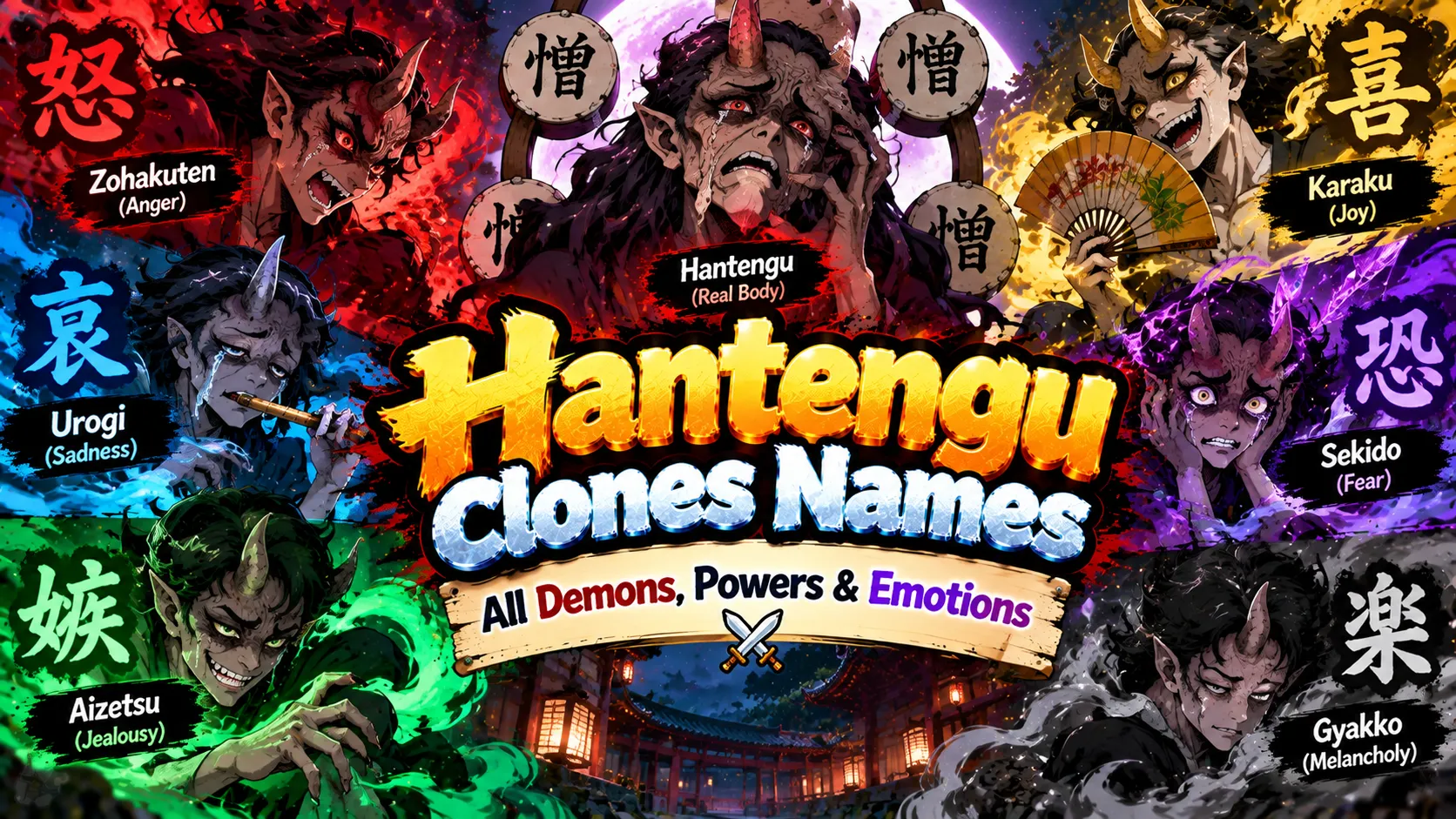
If you have watched Demon Slayer: Kimetsu no Yaiba, you probably remember Hantengu, the Upper Rank Four demon who can split into multiple powerful forms. Each clone represents a different emotion and has a distinct appearance, personality, and fighting ability.
The main Hantengu clones names are Sekido, Karaku, Aizetsu, and Urogi. These four demons represent anger, pleasure, sorrow, and joy. As the battle progresses, their powers combine to create even more dangerous forms, including Zohakuten, the embodiment of hatred.
In this guide, you will discover every major Hantengu form, what each name represents, their unique abilities, and how they work together during the Swordsmith Village Arc.
👹 Who Is Hantengu in Demon Slayer?
Hantengu is one of the Twelve Kizuki and holds the position of Upper Rank Four under Muzan Kibutsuji. Despite his frightened appearance, he is an extremely dangerous demon with a Blood Demon Art that allows him to divide into emotion-based clones.
His ability makes him difficult to defeat because each clone has its own personality and combat style. Instead of fighting as one opponent, Hantengu can overwhelm Demon Slayers with several powerful enemies at once.
Hantengu’s original body is small and cowardly-looking, but his clones possess impressive strength and specialized abilities. To defeat him, Tanjiro and the other Demon Slayers must understand how his power works and locate his true body.
⚔️ What Are the Hantengu Clones Names?
The four primary emotion clones are Sekido, Karaku, Aizetsu, and Urogi. Each one represents a different emotional state and uses a distinct fighting technique.
| Clone Name | Emotion | Main Ability |
|---|---|---|
| Sekido | Anger | Lightning attacks |
| Karaku | Pleasure | Powerful wind blasts |
| Aizetsu | Sorrow | Long-range spear combat |
| Urogi | Joy | Flight and sound-based attacks |
| Zohakuten | Hatred | Wood dragons and combined powers |
| Urami | Resentment | Enlarged form that conceals Hantengu |
Zohakuten and Urami are additional forms rather than members of the original group of four emotion clones. They become important as Hantengu’s battle develops.
🔴 1. Sekido — The Anger Clone
Sekido represents anger and is recognizable by his red hair, sharp expression, and intense personality. Among the four primary clones, he is particularly aggressive and often takes control when the emotions become difficult to manage.
His Blood Demon Art allows him to generate and manipulate lightning through his staff. These electrical attacks can stun or injure opponents, making him a serious threat even to experienced Demon Slayers.
Sekido’s personality matches his name and emotional role. He becomes irritated quickly, shows little patience, and prefers direct attacks over playful behavior.
Key facts about Sekido:
- Emotion: Anger
- Appearance: Red hair and a fierce expression
- Weapon: Staff
- Main power: Lightning manipulation
- Personality: Aggressive, impatient, and controlling
Sekido is also important because he plays a major role in the development of Zohakuten, the more powerful hatred form.
🟢 2. Karaku — The Pleasure Clone
Karaku represents pleasure and enjoys combat more than the other emotion clones. He has green hair and a relaxed expression, often appearing amused even when facing powerful opponents.
His signature weapon is a large leaf-shaped fan. By swinging it, Karaku creates powerful gusts of wind capable of throwing enemies away and damaging their surroundings.
Although his personality seems carefree, his ability is extremely dangerous. His wind attacks can disrupt an opponent’s movements and make it difficult to approach him safely.
Key facts about Karaku:
- Emotion: Pleasure
- Appearance: Green hair and a relaxed expression
- Weapon: Large leaf-shaped fan
- Main power: Powerful wind blasts
- Personality: Playful, confident, and carefree
Karaku’s laid-back attitude contrasts with Sekido’s anger, making their personalities easy to distinguish during the Swordsmith Village battle.
🔵 3. Aizetsu — The Sorrow Clone
Aizetsu represents sorrow and is recognizable by his blue hair and melancholy expression. Compared with Sekido and Karaku, he appears more serious and gloomy.
His primary weapon is a spear, which allows him to attack enemies from a distance. Aizetsu uses precise thrusting attacks and can pressure opponents without relying on the same elemental abilities as his fellow clones.
His personality reflects sadness and pessimism. He often speaks in a subdued manner, making him one of the more emotionally reserved members of the group.
Key facts about Aizetsu:
- Emotion: Sorrow
- Appearance: Blue hair and a sad expression
- Weapon: Spear
- Main power: Long-range spear attacks
- Personality: Gloomy, serious, and pessimistic
Aizetsu demonstrates that Hantengu’s clones are not simply copies of the same demon. Each one has a different way of fighting and a recognizable emotional identity.
🟡 4. Urogi — The Joy Clone
Urogi represents joy and has one of the most distinctive appearances among Hantengu’s clones. He has birdlike features, wings, and a cheerful, energetic personality.
Unlike the other three primary clones, Urogi can fly. His aerial mobility gives him a major advantage because he can attack from above and avoid some ground-based attacks.
He can also produce powerful sound waves through his mouth. These attacks can damage opponents and make close combat especially dangerous.
Key facts about Urogi:
- Emotion: Joy
- Appearance: Birdlike features and wings
- Main powers: Flight and sound-based attacks
- Fighting style: Aerial combat and sonic attacks
- Personality: Energetic, cheerful, and excited
Urogi’s joyful behavior creates an interesting contrast with Aizetsu’s sadness and Sekido’s anger. His flight also makes him one of the most visually distinctive Hantengu clones.
🟣 5. Zohakuten — The Hatred Form
Zohakuten is one of Hantengu’s most powerful forms. He emerges when the emotion clones combine their power, with Sekido taking the leading role in the transformation.
Unlike the four primary clones, Zohakuten represents hatred. His appearance is younger-looking than Hantengu’s original body, but his abilities make him an exceptionally dangerous opponent.
His Blood Demon Art creates wooden dragons that attack enemies with enormous force. He can also combine the abilities associated with the other clones, making it difficult for Demon Slayers to predict his next move.
Key facts about Zohakuten:
- Emotion: Hatred
- Appearance: Young-looking demon with a distinctive drum arrangement
- Main power: Wooden dragon attacks
- Fighting style: Large-scale attacks and combined abilities
- Role: A powerful form created from the emotion clones
Zohakuten becomes a major obstacle for Tanjiro, Nezuko, Genya, and Mitsuri Kanroji during the Swordsmith Village Arc.
🟤 6. Urami — The Resentment Form
Urami is associated with resentment and appears as an enormous version of Hantengu. This form is different from the four primary emotion clones and Zohakuten.
His large body makes him intimidating, but his role in the battle is particularly connected to Hantengu’s survival. The tiny original demon can hide within this enlarged form, complicating the effort to identify and destroy his true body.
Urami’s appearance emphasizes Hantengu’s ability to use his Blood Demon Art for deception and survival rather than relying only on direct combat.
Key facts about Urami:
- Emotion associated with the form: Resentment
- Appearance: An enormous demon form
- Main role: Conceals Hantengu’s tiny original body
- Fighting style: Uses his size and physical strength
- Importance: Makes locating the real Hantengu more difficult
Urami is an important part of understanding the full battle, although he is not one of the original four emotion clones.
🧠 What Emotions Do Hantengu’s Clones Represent?
Hantengu’s ability connects his clones to different emotions. Each emotional identity influences the clone’s personality, appearance, and fighting style.
| Name | Emotion | Personality |
|---|---|---|
| Sekido | Anger | Aggressive and impatient |
| Karaku | Pleasure | Relaxed and playful |
| Aizetsu | Sorrow | Gloomy and pessimistic |
| Urogi | Joy | Cheerful and energetic |
| Zohakuten | Hatred | Hostile and intimidating |
| Urami | Resentment | Survival-focused and deceptive |
The emotions help make the clones memorable because viewers can identify each character through more than just appearance. Their personalities also influence how they respond to danger and interact with one another.
💥 How Does Hantengu’s Blood Demon Art Work?
Hantengu’s Blood Demon Art allows him to split into emotion-based forms when certain conditions are met. Each clone becomes a separate combatant with its own abilities and personality.
This power gives Hantengu several advantages. His enemies must fight multiple opponents, adapt to different fighting styles, and work out which body they actually need to defeat.
The clones can also combine their abilities to create stronger forms. Zohakuten is the clearest example of this, bringing together powers associated with the earlier manifestations.
One of the most important details is that defeating the visible clones does not necessarily defeat Hantengu. The real demon can remain hidden, so finding his original body is essential to ending the fight.
🗡️ Why Are Hantengu’s Clones So Difficult to Defeat?
Hantengu’s clones make him dangerous because they attack in different ways and force Demon Slayers to divide their attention.
Several factors make the battle especially challenging:
- Multiple opponents: The clones can fight simultaneously.
- Different abilities: Lightning, wind, spear attacks, flight, and sound-based attacks require different responses.
- Powerful combinations: Zohakuten combines abilities into a more threatening form.
- A hidden original body: Hantengu can remain concealed while the other forms occupy his enemies.
- Constant pressure: Fighting the clones makes it harder to search for the real demon.
The combination of these features turns the Swordsmith Village battle into a test of teamwork, awareness, endurance, and quick decision-making.
🎬 Hantengu Clones in the Swordsmith Village Arc
The Hantengu battle takes place during the Swordsmith Village Arc of Demon Slayer. Tanjiro Kamado and Nezuko Kamado encounter the demon while visiting the village, and the conflict escalates as Hantengu’s clones appear.
Genya Shinazugawa and Mitsuri Kanroji also play important roles in the struggle. Each character contributes to the effort to survive the clones’ attacks and discover the original demon’s location.
The battle is memorable because Hantengu changes the usual structure of a demon fight. Rather than confronting one enemy with a single fighting style, the Demon Slayers face several opponents whose abilities and personalities differ significantly.
Zohakuten’s appearance raises the stakes further, while the need to locate the tiny original body adds another layer of difficulty.
❓ Frequently Asked Questions
What are the four main Hantengu clones’ names?
The four main clones are Sekido, Karaku, Aizetsu, and Urogi. They represent anger, pleasure, sorrow, and joy, respectively.
What is the strongest Hantengu clone?
Zohakuten is generally considered the most powerful of Hantengu’s major emotion-based forms. He combines abilities associated with the other clones and uses powerful wooden dragon attacks.
Which Hantengu clone represents anger?
Sekido represents anger. He has red hair, uses a staff, and can generate powerful lightning attacks.
Which Hantengu clone represents joy?
Urogi represents joy. He has birdlike features, can fly, and attacks with powerful sound waves.
Which Hantengu clone represents sorrow?
Aizetsu represents sorrow. He has blue hair, a gloomy personality, and fights using a spear.
Which Hantengu clone represents pleasure?
Karaku represents pleasure. He uses a large leaf-shaped fan to produce powerful gusts of wind.
Is Zohakuten one of the original four clones?
No. Zohakuten is a more powerful form created when the emotion clones combine their abilities. He represents hatred rather than one of the original four emotions.
Is Urami a Hantengu clone?
Urami is an additional form associated with resentment. His enormous body helps conceal Hantengu’s tiny original body during the battle.
Why does Hantengu split into different forms?
His Blood Demon Art manifests different emotions as separate forms. This ability allows him to overwhelm enemies with multiple fighting styles and makes his true body difficult to locate.
Who defeats Hantengu?
Tanjiro and the other Demon Slayers work together during the Swordsmith Village battle to overcome Hantengu’s forms and locate his original body. The fight requires teamwork and careful timing rather than simply defeating the visible clones.
🏁 Final Thoughts
The Hantengu clones are among the most distinctive enemies in Demon Slayer: Kimetsu no Yaiba. Sekido, Karaku, Aizetsu, and Urogi represent four contrasting emotions, while Zohakuten and Urami reveal additional layers of Hantengu’s dangerous Blood Demon Art.
Remember the main names by connecting each one to its emotion: Sekido is anger, Karaku is pleasure, Aizetsu is sorrow, and Urogi is joy. Zohakuten represents hatred, while Urami is associated with resentment.
Together, these forms make Hantengu’s battle one of the most complex encounters in the Swordsmith Village Arc.

Michael Harris is a content writer at NamelyHub, where he shares creative and unique name ideas for every purpose. With a strong interest in branding and modern naming trends, he creates helpful collections of names for pets, teams, businesses, and more.
His goal is to make finding the perfect name simple, inspiring, and accessible for everyone.