
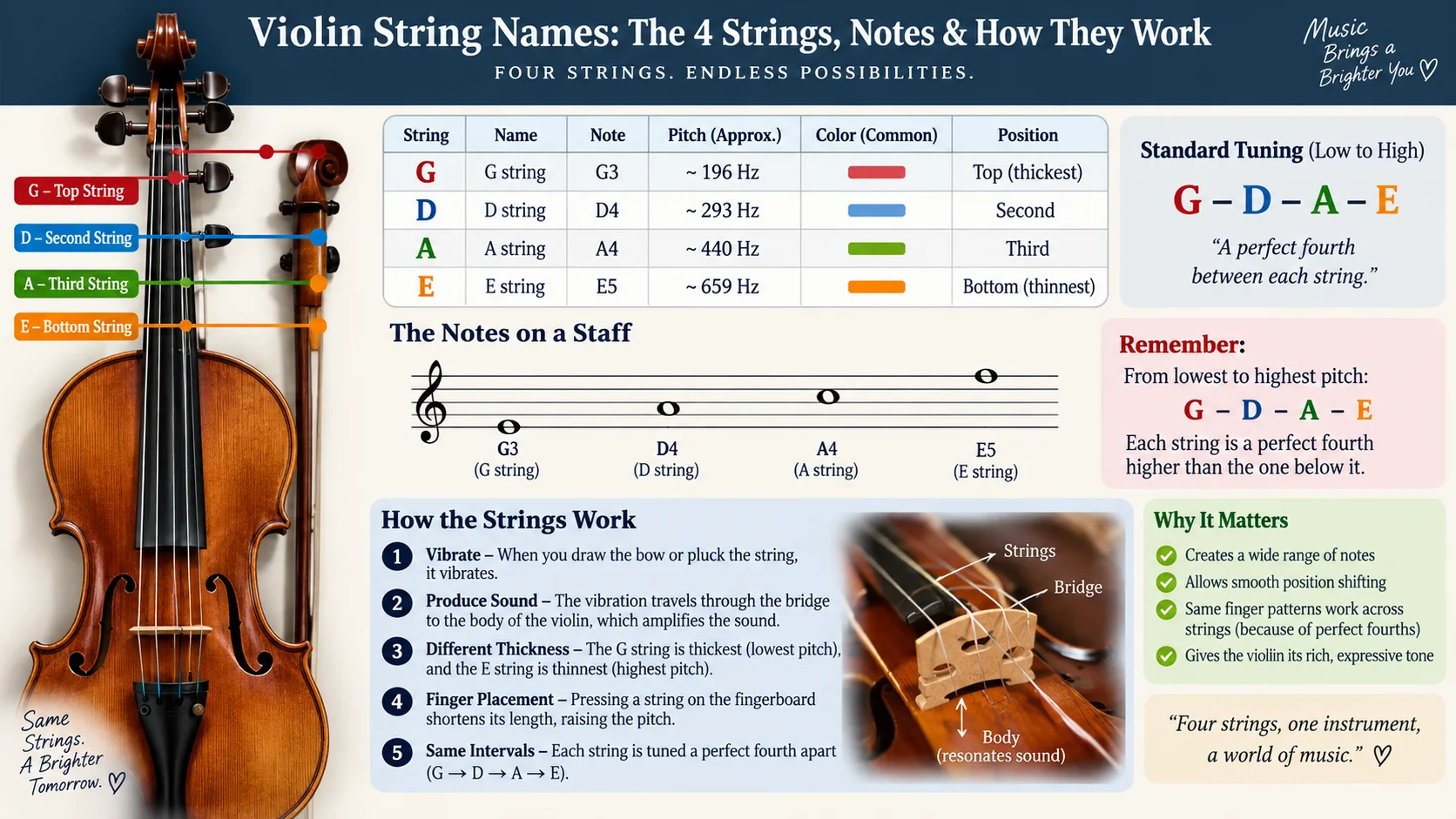
Violin string names are G, D, A, and E, arranged from the lowest-pitched string to the highest-pitched string. These four strings create the standard tuning used on a violin, with each string separated from the next by a perfect fifth. Learning the violin string names is one of the first steps for beginners because it makes tuning, reading music, practicing scales, and understanding the fingerboard much easier.
The four violin strings may look similar at first, but each one has a different pitch, thickness, and role. The G string produces the lowest sound, while the E string produces the highest. The D and A strings sit between them and help create the balanced range that makes the violin so versatile. Strings can also differ in material, tension, gauge, and construction, which can change the instrument’s tone and playing response. In this guide, you will learn the names of all four violin strings, their notes, tuning order, materials, string types, and useful tips for choosing and replacing them. 🎻
🎻 What Are the Four Violin String Names?
The four standard violin string names are G, D, A, and E. From the thickest and lowest string to the thinnest and highest string, the order is G, D, A, E.
| String | Open Note | Relative Pitch | Typical Role |
|---|---|---|---|
| G | G3 | Lowest | Deep, warm tones |
| D | D4 | Low-middle | Warm and rich |
| A | A4 | Middle | Bright, clear center |
| E | E5 | Highest | Brilliant, focused tones |
The strings are tuned in perfect fifths. This means the pitch relationship between G and D, D and A, and A and E is the same musical interval. Memorizing this order helps beginners quickly identify strings while practicing.
🎼 G String: The Lowest Violin String
The G string is the thickest and lowest-pitched standard violin string. Its open-string pitch is G3. Because it produces the deepest sound on the violin, it is often associated with warm, rich, and powerful tones.
The G string is frequently used for lower melodies, accompaniment patterns, double stops, scales, and expressive passages. Its larger diameter compared with the other strings gives it a different physical feel under the bow and fingers.
G string facts:
- String name: G
- Open note: G3
- Lowest standard violin string
- Usually the thickest string
- Produces a deep and warm tone
- Located closest to the player’s left side when holding the violin normally
- Commonly used for lower-register playing
- Tuned below the D string
- Separated from D by a perfect fifth
- Often favored for rich, resonant passages
🎻 D String: The Warm Middle-Low String
The D string is the second-lowest violin string and has an open pitch of D4. It sits between the G and A strings and provides an important bridge between the violin’s lower and middle registers.
Many players appreciate the D string for its balanced tone. It can sound warm without being as deep as G, while also providing enough clarity for melodies and technical exercises.
D string facts:
- String name: D
- Open note: D4
- Second-lowest standard string
- Thinner than G
- Thicker than A
- Often produces a warm, rounded sound
- Tuned above G
- Tuned below A
- Separated from G by a perfect fifth
- Common in scales and melodies
🎶 A String: The Central Violin String
The A string has an open pitch of A4 and sits between the D and E strings. It is often considered a central string because many beginner exercises, melodies, and tuning references use A as an important point of reference.
The A string has a brighter sound than G and D while remaining less high-pitched than E. It is also frequently used in violin music because many melodies naturally sit comfortably within its range.
A string facts:
- String name: A
- Open note: A4
- Third string from the low end
- Higher than D
- Lower than E
- Usually thinner than D
- Produces a clear and focused tone
- Tuned above D
- Tuned below E
- Separated from D by a perfect fifth
✨ E String: The Highest Violin String
The E string is the thinnest and highest standard violin string. Its open pitch is E5. It produces the bright, brilliant, and focused upper register that is one of the violin’s most recognizable characteristics.
Because it is the highest string, the E string is often used for high melodies, expressive passages, harmonics, and brilliant musical effects. Beginners should handle it carefully because its thin construction makes it feel different from the lower strings.
E string facts:
- String name: E
- Open note: E5
- Highest standard violin string
- Usually the thinnest string
- Produces a bright and brilliant tone
- Located above the A string in pitch
- Tuned above A
- Separated from A by a perfect fifth
- Commonly used for high notes
- Important for bright melodic passages
🎼 Violin Strings in Order From Lowest to Highest
Remembering violin strings in order is simple: G, D, A, E. This sequence moves from the lowest pitch to the highest pitch.
A useful beginner memory trick is G-D-A-E. Some teachers use phrases to help students remember the order, but simply practicing the four letters repeatedly can be even more useful because the sequence becomes automatic.
When looking at the violin from the player’s position, the strings progress from the low G string toward the high E string. The physical thickness also generally decreases as the pitch rises.
🔊 What Notes Are the Open Violin Strings?
The open violin strings produce four notes without pressing a finger against the fingerboard:
- G3
- D4
- A4
- E5
These open strings are fundamental to violin technique. Players use them for tuning, scales, exercises, drones, double stops, and musical passages.
The A string is particularly important during tuning because many violinists tune it to 440 Hz for A4 in standard concert tuning. Once A is correctly tuned, the other strings can be adjusted using perfect-fifth relationships.
🎵 Why Are Violin Strings Tuned in Perfect Fifths?
Violin strings are tuned in perfect fifths because this tuning system provides a useful and efficient layout across the instrument’s fingerboard. The open strings G, D, A, and E create a consistent interval pattern.
This arrangement allows violinists to play scales, arpeggios, double stops, chords, and melodies across adjacent strings with predictable relationships between notes.
The tuning also contributes to the violin’s broad range and helps players move naturally between strings during both beginner exercises and advanced repertoire.
🔧 How Are Violin Strings Tuned?
Standard violin tuning uses the four open notes G, D, A, and E. Players generally tune the A string first, then tune the other strings in relation to it.
Fine tuners can make small pitch adjustments, while the tuning pegs are generally used for larger changes. Beginners should make small adjustments because violin strings are under significant tension.
When tuning, turn the peg slowly and carefully. Avoid making sudden large movements, especially with the thin E string. If you are new to tuning a violin, having an experienced player or teacher help you can make the process much easier.
🧵 What Are Violin Strings Made Of?
Violin strings can be made using different materials and constructions. Modern strings commonly use synthetic-core or steel-core designs, while traditional gut-core strings are still used by some players.
Different materials can produce noticeably different tonal qualities and playing responses. Steel strings often have a direct and focused response, synthetic-core strings can offer a broad range of tonal colors, and gut strings are known for distinctive complex tonal characteristics.
The choice depends on the violin, player’s technique, musical style, and personal preference.
🎻 Types of Violin Strings
There are several broad categories of violin strings, and each can create a different playing experience. The most common choices include steel-core, synthetic-core, and gut-core strings.
Steel-Core Violin Strings
Steel-core strings generally have a strong, focused response and can be durable and stable. They are commonly chosen by players who want a direct sound and quick response.
Synthetic-Core Violin Strings
Synthetic-core strings use a synthetic material inside the string and are popular because they can provide a warm, complex, and versatile sound. They are widely used by students and advanced players.
Gut-Core Violin Strings
Gut strings use animal gut as their core material. They have a long historical tradition and can produce a complex and nuanced sound, although they typically require more careful maintenance and can be more sensitive to environmental changes.
📏 What Is Violin String Gauge?
String gauge refers to the thickness or diameter of a string. Different gauges can affect tension, response, projection, and tone.
A thicker string may produce a different tonal response from a thinner string, while tension also influences how the instrument feels under the bow and fingers. String gauge is not something beginners should change casually because the best choice depends on the violin and its setup.
If you want to experiment with different gauges, it is wise to ask a violin teacher or qualified luthier for advice.
💡 How Long Do Violin Strings Last?
There is no single replacement schedule that works for every violinist. String lifespan depends on how frequently you play, how much you sweat, the string material, playing style, and environmental conditions.
A frequently played violin may need strings replaced much more often than an instrument that is played occasionally. Players may notice a loss of brightness, reduced responsiveness, rough surfaces, tuning instability, or a generally dull tone when strings become worn.
Regular players should pay attention to how their instrument sounds and responds rather than relying only on a calendar.
🔄 When Should You Replace Violin Strings?
You may need new strings when the existing ones show visible wear or no longer perform properly. A string that sounds dull or feels rough can affect your playing experience.
Common signs include:
- Dull or weak tone
- Difficulty staying in tune
- Visible wear
- Fraying or damaged winding
- Rough sections under the fingers
- Slow response
- Reduced projection
- Frequent string slippage
- Unusual buzzing
- A string that is close to breaking
If a string has visible damage, replace it rather than continuing to use it.
🛠️ How to Replace a Violin String
Replacing a violin string requires patience because the bridge and soundpost depend on the instrument maintaining proper setup and tension. When changing a string, keep the bridge aligned and avoid suddenly removing all four strings at once unless you know how to maintain the setup.
A typical replacement involves loosening and removing the old string, fitting the new string at the tailpiece and peg, winding it carefully around the peg, and gradually bringing it up to pitch. New strings stretch during the first several tuning sessions, so they may require repeated adjustment.
If you are a beginner, asking a teacher, violin shop, or luthier to demonstrate the process is a good idea.
🎯 Violin String Names for Beginners
Beginners only need to remember four letters at first:
G — D — A — E
Practice saying the sequence from low to high. Then practice identifying each string visually and by sound. Once you become comfortable, start learning the open-string notes and the finger patterns that create additional pitches.
Knowing the violin string names helps with lessons because teachers can give clear instructions such as play the open A string or start this exercise on the D string.
🎼 Violin String Notes and Finger Placement
Each open string provides a starting pitch, and pressing the string against the fingerboard shortens its vibrating length and raises its pitch. This allows violinists to create many different notes from each string.
For example, the open A string sounds A. Placing the fingers at different positions produces higher notes. The exact finger patterns depend on the musical key and position being played.
Learning open strings before learning finger placement gives beginners a useful foundation for scales and simple melodies.
🌟 How to Remember G, D, A, E
The easiest way to remember violin string names is to repeat the sequence from low to high:
G → D → A → E
You can practice by pointing to each string while saying its name. Another useful exercise is to have someone play a random open string and identify it by sound.
With regular practice, recognizing G, D, A, and E becomes automatic.
❓ Frequently Asked Questions About Violin String Names
What are the four violin string names?
The four standard violin string names are G, D, A, and E. From lowest to highest pitch, the order is G, D, A, E.
What is the lowest violin string?
The G string is the lowest-pitched standard violin string. Its open note is G3.
What is the highest violin string?
The E string is the highest-pitched standard violin string. Its open note is E5.
What are the violin strings tuned to?
Standard violin tuning is G3, D4, A4, and E5. The strings are tuned in perfect fifths.
Which violin string is the thickest?
The G string is generally the thickest of the four standard violin strings. The E string is generally the thinnest.
Which violin string is best for beginners?
Beginners use all four strings. The G, D, A, and E strings each have an important role, so students should become familiar with all four rather than focusing on one string.
How do you remember violin strings in order?
Remember the sequence G-D-A-E, from the lowest string to the highest. Repeating the four letters while identifying the strings visually is an effective way to memorize them.
How often should violin strings be changed?
String replacement depends on how often you play, string material, playing style, and wear. Replace strings when they become noticeably dull, damaged, unstable, or difficult to play.
🎻 Final Thoughts
Learning the violin string names is a small step that makes a big difference for every beginner. The four standard strings are G, D, A, and E, moving from the lowest-pitched G string to the highest-pitched E string. Each has its own tone, thickness, and role in violin playing.
Once you can identify the strings confidently, tuning, scales, finger placement, exercises, and music instructions become easier to understand. Whether you are buying replacement strings or simply starting your violin journey, knowing G, D, A, and E gives you an essential foundation for becoming a confident player. 🎻✨

Michael Harris is a content writer at NamelyHub, where he shares creative and unique name ideas for every purpose. With a strong interest in branding and modern naming trends, he creates helpful collections of names for pets, teams, businesses, and more.
His goal is to make finding the perfect name simple, inspiring, and accessible for everyone.