
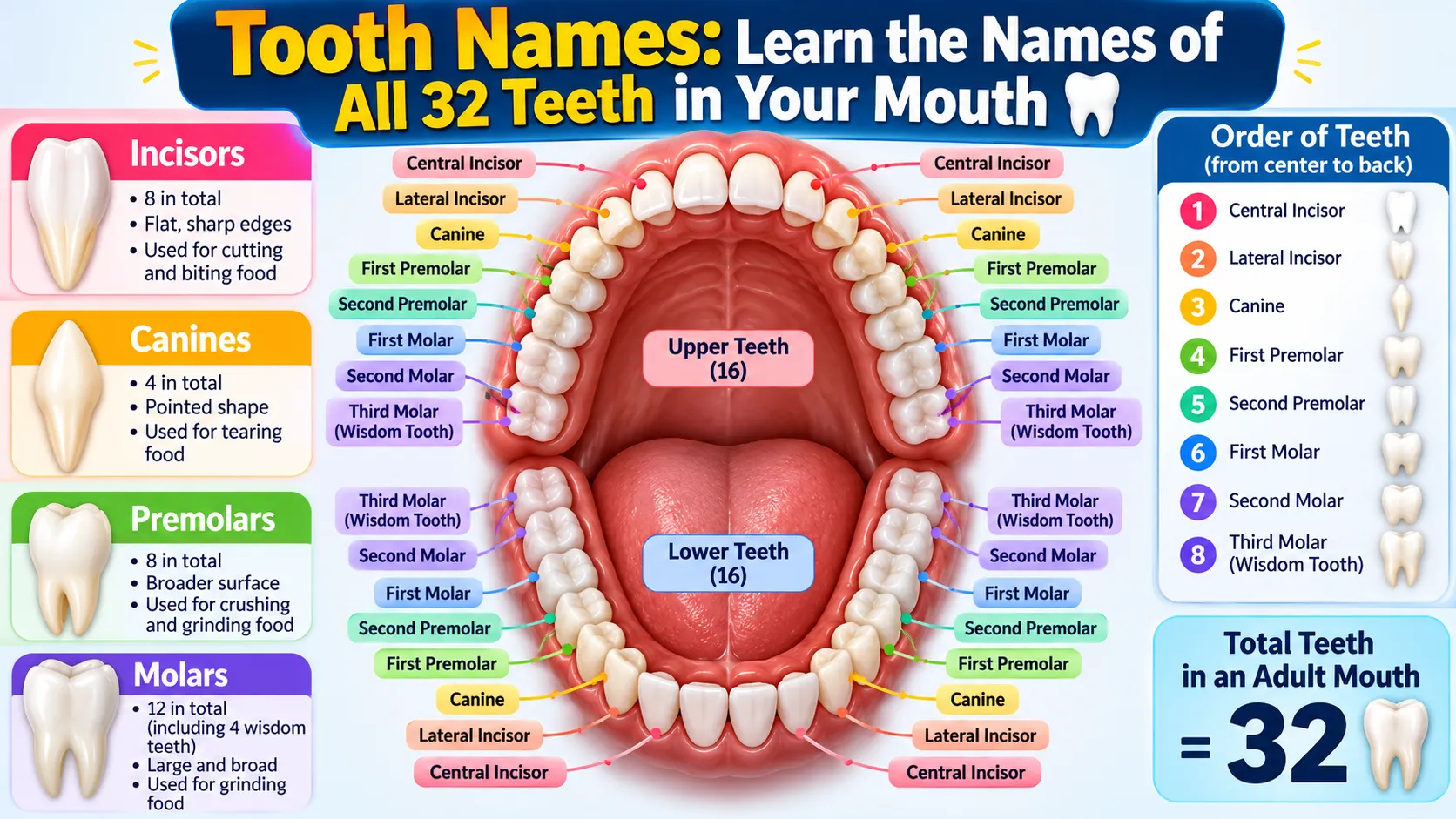
Have you ever wondered what the different teeth in your mouth are called and what each one does? Every tooth has a special name, shape, and purpose. Some teeth help you bite into an apple, others tear food apart, and the rest grind it into smaller pieces so you can swallow comfortably.
Learning the tooth names makes it easier to understand dental health, recognize different teeth, and communicate with your dentist. Adults typically have 32 permanent teeth, including wisdom teeth, while children usually have 20 primary teeth, also known as baby teeth. Each type plays an important role in eating, speaking, and maintaining a healthy smile.
In this guide, you will discover the names of all the main teeth, their locations, their functions, and the differences between adult and baby teeth.
🦷 What Are the Names of the Teeth?
Human teeth are divided into four main types: incisors, canines, premolars, and molars. Each type has a different shape and function, helping your mouth process food efficiently.
Here are the four main tooth names:
- Incisors: The flat, front teeth used for cutting and biting food.
- Canines: The pointed teeth located beside the incisors, used for tearing food.
- Premolars: The teeth behind the canines that help crush and grind food.
- Molars: The large, broad teeth at the back of the mouth that grind food into smaller pieces.
Adults usually have eight incisors, four canines, eight premolars, and twelve molars when all four wisdom teeth are present.
Children have a different arrangement because their primary teeth do not include premolars. Their 20 baby teeth consist of eight incisors, four canines, and eight molars.
😁 Incisors: The Front Teeth
Incisors are the eight front teeth located in the upper and lower jaws. They have relatively thin, flat edges that make them ideal for cutting food into manageable pieces.
When you bite into a sandwich, slice through a piece of fruit, or take a bite of a carrot, your incisors usually do much of the initial work.
There are four incisors in the upper jaw and four in the lower jaw. Each jaw has two central incisors and two lateral incisors.
Types of incisors
- Central incisors: The two front teeth in the upper jaw and the two front teeth in the lower jaw.
- Lateral incisors: The teeth immediately beside the central incisors, one on each side in both jaws.
Central incisors are generally wider than lateral incisors. Together, these teeth also play an important role in speech and the appearance of your smile.
Because incisors are located at the front of the mouth, they are highly visible when you smile. Keeping them clean helps maintain healthy gums and a bright, natural-looking smile.
🐺 Canine Teeth: The Pointed Teeth
Canine teeth are the four pointed teeth positioned beside the lateral incisors. They are sometimes called cuspids or eye teeth, particularly when referring to the upper canines.
Their pointed shape helps them grip and tear food. Canines also help guide the movement of the jaw during certain chewing movements.
There are four canine teeth in a typical adult mouth:
- Two upper canines.
- Two lower canines.
Canines have long roots compared with many other teeth, helping anchor them firmly in the jaw. Their position also contributes to the shape of the dental arch.
These teeth are important for biting into foods that require tearing, such as some meats or firmer foods. They also help maintain the alignment and appearance of the front teeth.
In children, primary canines eventually fall out and are replaced by permanent canines. The permanent upper canines often erupt during the later childhood years, although the timing varies from person to person.
🥜 Premolars: The Crushing Teeth
Premolars are located between the canine teeth and the molars. They are also known as bicuspids, although premolars do not always have exactly two cusps.
Most adults have eight premolars, with two on each side of the upper jaw and two on each side of the lower jaw.
Premolars help crush and grind food before it reaches the molars. Their surfaces are broader than those of incisors and canines, making them better suited to chewing.
Types of premolars
- First premolars: Located directly behind the canine teeth.
- Second premolars: Located behind the first premolars and in front of the first molars.
Premolars are permanent teeth that replace primary molars during childhood. Baby teeth do not include premolars, which is why children have fewer teeth than adults.
These teeth help distribute chewing pressure across the mouth. Their position and shape allow them to perform a combination of crushing and grinding functions.
🍎 Molars: The Large Back Teeth
Molars are the broad teeth located toward the back of the mouth. They have large chewing surfaces designed to grind food thoroughly.
Adults can have twelve molars, including the four wisdom teeth. However, not everyone develops all four wisdom teeth, and some people have them removed.
Molars are divided into first molars, second molars, and third molars.
- First molars: Located behind the second premolars.
- Second molars: Located behind the first molars.
- Third molars: Commonly known as wisdom teeth, located at the very back of the mouth when present.
First and second molars are important for everyday chewing. They help break food into smaller pieces before swallowing.
Wisdom teeth usually emerge in late adolescence or early adulthood, but their development varies. Some remain trapped beneath the gums, grow at an angle, or never develop at all.
Because molars have grooves and pits on their chewing surfaces, food particles and plaque can collect there. Brushing carefully and receiving regular dental checkups can help reduce the risk of cavities.
🧠 Wisdom Teeth: The Third Molars
Wisdom teeth are the third molars and are usually the last permanent teeth to develop. A person can have up to four wisdom teeth, although some people have fewer or none.
These teeth are located at the back of the upper and lower jaws. They often emerge between the late teens and mid-twenties, but the timing differs among individuals.
Wisdom teeth can sometimes cause problems when there is not enough room for them to emerge normally.
Possible issues include:
- Impaction: A wisdom tooth remains partly or completely trapped beneath the gum.
- Pain or swelling: The surrounding tissues may become irritated.
- Cleaning difficulties: Their position can make brushing and flossing harder.
- Gum infection: Partially erupted wisdom teeth can allow food and bacteria to collect beneath the gum.
- Damage to nearby teeth: Certain positions may create problems for the neighboring molars.
Not every wisdom tooth needs to be removed. A dentist can examine the teeth and use dental X-rays when appropriate to determine whether monitoring or treatment is necessary.
If you experience persistent pain, swelling, a bad taste, or difficulty opening your mouth around a wisdom tooth, arrange a dental assessment.
📊 Tooth Names and Their Functions at a Glance
The following table provides a simple comparison of the four main types of permanent teeth.
| Tooth name | Number in adults | Main function | Location |
|---|---|---|---|
| Incisors | 8 | Cutting and biting | Front of the mouth |
| Canines | 4 | Tearing food | Beside the incisors |
| Premolars | 8 | Crushing and grinding | Between canines and molars |
| Molars | 12 | Grinding food | Back of the mouth |
| Total | 32 | Biting and chewing | Upper and lower jaws |
This total assumes that all four wisdom teeth are present. If one or more wisdom teeth never develop or have been removed, the total number of teeth may be lower.
🦷 Names of the Upper Teeth
The upper teeth are located in the maxilla, the upper jawbone. In a typical adult with all permanent teeth, there are sixteen teeth in the upper jaw.
The names of the upper teeth, moving from the center of the mouth toward the back on either side, are:
- Central incisor.
- Lateral incisor.
- Canine.
- First premolar.
- Second premolar.
- First molar.
- Second molar.
- Third molar, or wisdom tooth.
This arrangement occurs on both the left and right sides of the upper jaw.
The upper incisors are especially visible when you smile or speak. The upper molars help grind food and work together with the lower molars during chewing.
The roots of the upper back teeth are close to the maxillary sinuses in some people. This is one reason a dentist may consider sinus-related issues when evaluating certain types of upper tooth pain.
😬 Names of the Lower Teeth
The lower teeth are located in the mandible, or lower jawbone. A typical adult has sixteen lower teeth when all permanent teeth, including the wisdom teeth, are present.
Moving from the center toward the back on either side, the lower teeth are:
- Central incisor.
- Lateral incisor.
- Canine.
- First premolar.
- Second premolar.
- First molar.
- Second molar.
- Third molar, or wisdom tooth.
The same arrangement appears on both sides of the lower jaw.
Lower incisors help cut food, while lower canines assist with tearing. The premolars and molars work with the upper teeth to crush and grind food during chewing.
The lower jaw moves during speaking, eating, and yawning. Healthy teeth and supporting tissues help the upper and lower teeth meet in a functional bite.
👶 Baby Teeth Names: The 20 Primary Teeth
Children usually develop twenty primary teeth, commonly called baby teeth or milk teeth. These teeth help children chew food, learn to speak clearly, and maintain space for the permanent teeth that develop later.
Baby teeth begin to emerge during infancy. Most children have their full set by around age three, although normal eruption timing varies.
Unlike adult teeth, baby teeth include no premolars. Their arrangement consists of incisors, canines, and molars.
Names of baby teeth
- Central incisors: Four front teeth, with two in the upper jaw and two in the lower jaw.
- Lateral incisors: Four teeth beside the central incisors.
- Canines: Four pointed teeth, one on each side of the incisors in each jaw.
- First molars: Four molars positioned behind the canines.
- Second molars: Four molars located at the back of the primary dental arches.
These teeth eventually loosen and fall out as permanent teeth develop beneath them. The permanent successors include incisors, canines, and premolars, while the permanent molars emerge farther back in the mouth.
Even though baby teeth are temporary, they need regular brushing and dental care. Untreated cavities can cause pain, infection, and difficulties with eating.
🪥 Difference Between Baby Teeth and Adult Teeth
Baby teeth and adult teeth differ in number, size, and structure. Understanding these differences helps parents know what to expect as children grow.
| Feature | Baby teeth | Adult teeth |
|---|---|---|
| Common number | 20 | Up to 32 |
| Other name | Primary teeth | Permanent teeth |
| Premolars | None | 8 |
| Wisdom teeth | None | Up to 4 |
| General appearance | Smaller and often whiter | Usually larger |
| Purpose | Early chewing and speech development | Long-term chewing and speech |
| Replacement | Usually shed during childhood | Usually intended to last a lifetime |
Primary teeth generally begin falling out around age six as permanent teeth start to emerge. The transition continues through the early teenage years for most children.
Permanent teeth are not naturally replaced if they are lost. This makes daily oral hygiene and preventive dental care important throughout adulthood.
🔢 How Many Teeth Do Adults Have?
Most adults have 32 permanent teeth when all four wisdom teeth are included. These teeth are divided between the upper and lower jaws, with sixteen in each jaw.
The breakdown is:
- Eight incisors.
- Four canines.
- Eight premolars.
- Twelve molars, including four wisdom teeth.
However, not every adult has 32 teeth. Some people never develop one or more wisdom teeth, while others have teeth removed because of decay, gum disease, crowding, or other dental problems.
An adult with all four wisdom teeth removed and no other missing permanent teeth will generally have 28 teeth.
The exact number can differ because of individual development and dental history. A dentist can confirm how many teeth are present and whether any teeth remain unerupted beneath the gums.
👄 How Many Teeth Do Children Have?
Children usually have twenty primary teeth once their baby teeth have fully erupted. These include eight incisors, four canines, and eight molars.
The first baby teeth often appear at around six months of age, although some babies develop them earlier or later. The lower central incisors are often among the first to emerge.
As children grow, the primary teeth begin to loosen and fall out. Permanent teeth gradually replace them, while permanent molars emerge behind the baby teeth without replacing a primary tooth.
During the mixed-dentition stage, a child has both baby teeth and permanent teeth. This commonly occurs throughout the elementary-school years.
The number of teeth present at a particular age depends on the child’s development. If a tooth seems significantly delayed or a child experiences pain or swelling, a dentist can evaluate the situation.
🩺 Why Are Tooth Names Important?
Knowing tooth names can help you understand dental appointments, oral health information, and treatment recommendations.
Dentists often refer to specific tooth types or use a numbering system to identify individual teeth. Learning basic terminology makes it easier to follow conversations about cavities, fillings, orthodontic treatment, and other procedures.
Here are some practical benefits of learning tooth names:
- Better communication: You can describe which part of your mouth hurts.
- Easier dental education: You can understand explanations about incisors, canines, premolars, and molars.
- Improved oral hygiene: Knowing where different teeth are located can help you brush more carefully.
- Understanding dental records: Tooth names and numbers help identify the teeth discussed during treatment.
- Helping children learn: Parents can explain the purpose of each type of tooth in simple language.
Remember that identifying the general location of a painful tooth does not establish the cause of the pain. A dental examination may be necessary to determine what is happening.
🧼 How to Keep Every Tooth Healthy
Every tooth deserves care, from the front incisors to the back molars. A consistent oral hygiene routine helps remove plaque and lowers the risk of cavities and gum disease.
Follow these everyday habits:
- Brush twice daily: Use fluoride toothpaste and brush for about two minutes each time.
- Clean between teeth: Use floss or another suitable interdental cleaner daily.
- Pay attention to molars: Brush the chewing surfaces and the back teeth carefully.
- Limit frequent sugary snacks: Repeated exposure to sugar can increase the risk of tooth decay.
- Drink water regularly: Water helps rinse the mouth, and fluoridated tap water can support enamel health.
- Attend dental checkups: A dentist can identify problems early and recommend preventive care.
- Protect your teeth during sports: Use an appropriate mouthguard when needed.
- Avoid using teeth as tools: Do not use your teeth to open packaging or bite hard objects.
If you notice persistent tooth pain, bleeding gums, swelling, sensitivity, or a broken tooth, seek advice from a dental professional rather than relying on tooth names alone to diagnose the issue.
❓ Frequently Asked Questions About Tooth Names
What are the four main types of teeth?
The four main types are incisors, canines, premolars, and molars. Incisors cut food, canines tear it, premolars crush it, and molars grind it.
What are the names of all 32 adult teeth?
Adult teeth are classified as eight incisors, four canines, eight premolars, and twelve molars. The molars include up to four wisdom teeth.
What are the two front teeth called?
The two front teeth in the upper jaw are the upper central incisors. The two front teeth in the lower jaw are the lower central incisors.
What are the pointed teeth called?
The pointed teeth beside the incisors are called canines. They are also known as cuspids and are used to help tear food.
What are the teeth at the back of the mouth called?
The teeth at the back are primarily premolars and molars. The third molars, when present, are called wisdom teeth and sit at the very back.
What are wisdom teeth?
Wisdom teeth are the third molars. They usually develop later than other permanent teeth and may emerge in late adolescence or early adulthood.
How many teeth do children have?
Children typically have twenty primary teeth when their baby teeth have fully erupted. These include eight incisors, four canines, and eight molars.
Do baby teeth have premolars?
No. Baby teeth do not include premolars. Primary molars eventually fall out and are replaced by permanent premolars.
Which teeth are used for biting?
Incisors are the main teeth used for biting and cutting food. Canines may also help grip and tear certain foods.
Which teeth are used for grinding food?
Premolars and molars help crush and grind food. Molars have broad chewing surfaces that are particularly suited to grinding.
Can adults have fewer than 32 teeth?
Yes. Some adults naturally develop fewer than four wisdom teeth, while others have had teeth removed. Adults with 28 teeth may have all their wisdom teeth removed and all their other permanent teeth intact.
What is the difference between premolars and molars?
Premolars are located between the canines and molars and help crush and grind food. Molars are larger back teeth with broad surfaces that are especially effective for grinding.
🌟 Conclusion
Learning the different tooth names helps you understand how your mouth works and why each tooth matters. Incisors cut food, canines tear it, premolars crush it, and molars grind it. Together, they support eating, speaking, and a healthy smile.
Adults typically have 32 permanent teeth, including wisdom teeth, while children usually have 20 primary teeth. Understanding the difference between these sets can make dental education easier for parents, students, and anyone interested in oral health.
Remember to brush twice daily with fluoride toothpaste, clean between your teeth, and visit your dentist regularly. With consistent care, you can help protect your natural teeth and maintain a healthy smile.

Michael Harris is a content writer at NamelyHub, where he shares creative and unique name ideas for every purpose. With a strong interest in branding and modern naming trends, he creates helpful collections of names for pets, teams, businesses, and more.
His goal is to make finding the perfect name simple, inspiring, and accessible for everyone.