
Roses and daisies are lovely. But sometimes a person wants something different. Something rare. Something that makes people ask “what flower is that?” Rare flower names carry mystery and beauty. They spark curiosity and feel like secrets whispered by nature. 🌸
This guide gathers over 350 rare flower names from every continent. Some come from remote islands. Others grow only on specific mountain ranges. A few exist only in botanical gardens. Each name has a story. Each bloom has unique characteristics. Let us explore the hidden treasures of the plant world. 🌺
What Are Rare Flower Names?
Rare flower names belong to plant species with limited distribution. Some grow in one location on Earth. Others exist only in cultivation. Many have never been seen by most gardeners. The names often come from Greek or Latin roots. Some honor explorers or scientists. Others describe unusual flower shapes or colors. 🎯
A rare flower name differs from common names like rose or tulip. These plants are not found at local nurseries. Seeds might not be available commercially. Some are protected species. Others are extinct in the wild and survive only in botanical collections. 💙
Ghost Orchid (Dendrophylax lindenii) 👻
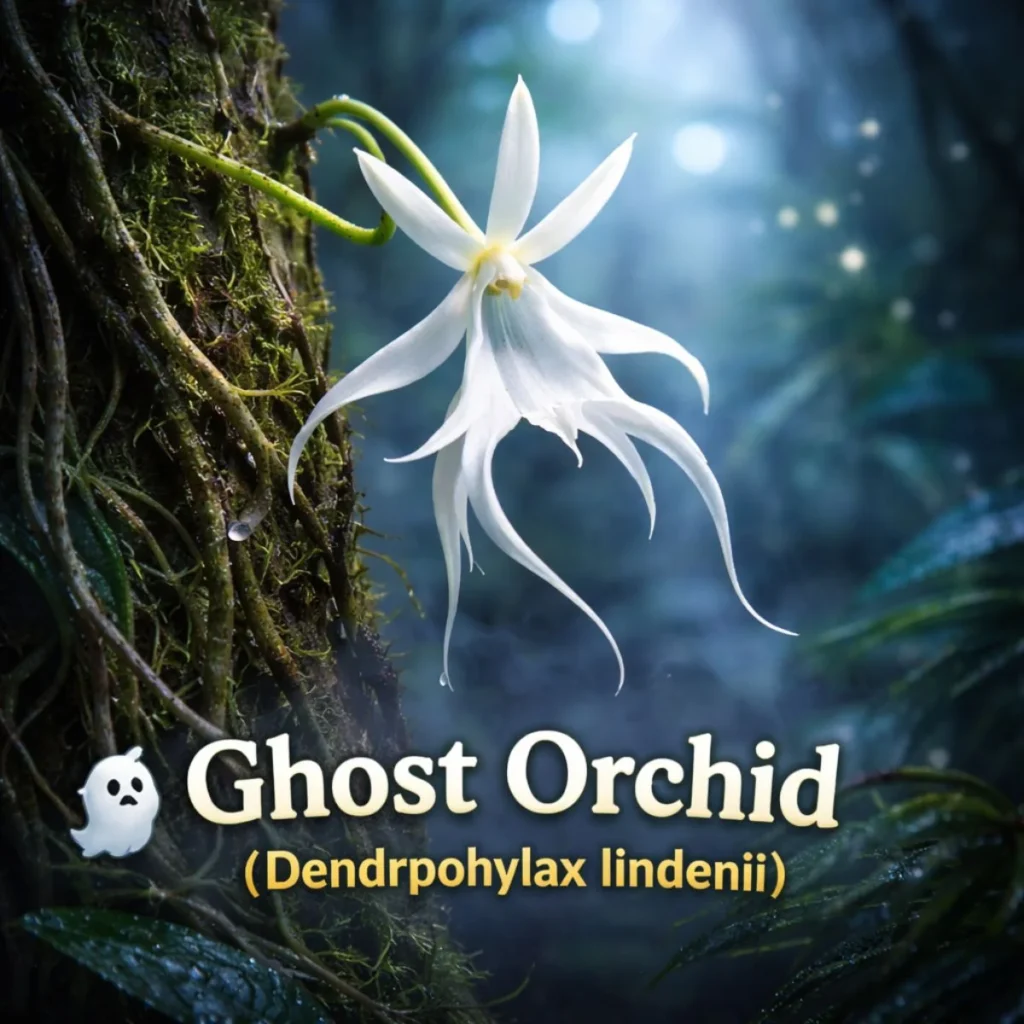
This leafless orchid from Florida and Cuba is one of the rarest flowers on Earth.
- Found only in South Florida and Cuba – specific swamp habitats
- No leaves – photosynthesis happens in green roots
- White flowers appear to float in air – ghost like appearance
- Flowers bloom between June and August – only once per year
- Pollinated by giant sphinx moth – has foot long tongue
- Listed as endangered species – protected by law
- Fewer than 2000 plants remain in the wild – habitat loss major threat
- Featured in book and film The Orchid Thief – also Adaptation movie
- Cultivation nearly impossible – requires specific fungus
- Roots blend into tree bark – very hard to spot
- Flower shape looks like frog legs – also called palm polly
- Discovered in 1844 by Jean Jules Linden – Belgian botanist
- Requires high humidity and warm temperatures – 70 to 85 degrees
- Cannot be transplanted from wild – removal kills plant
- Seeds have no nutrients – need specific mycorrhizal fungi to grow
Middlemist Red (Middlemist camellia) 🌹
This camellia survives in only two locations on Earth. Both are gardens, not the wild.
- Only two known living specimens exist – one in New Zealand, one in England
- Originally from China – extinct in its native habitat
- Brought to England in 1804 by John Middlemist – plant collector
- Deep pink to red flowers – not actually red but called red
- Flowers are large and showy – up to 4 inches across
- Blooms in late winter to early spring – February to March
- Leaves are dark green and glossy – typical camellia foliage
- Grows as shrub up to 12 feet tall – can be pruned smaller
- Requires acidic well draining soil – pH between 5.5 and 6.5
- Prefers partial shade – morning sun only
- One specimen at Chiswick House in London – under glass for protection
- Other specimen at Waitangi Treaty Grounds in New Zealand
- Both plants are clones of same original – no genetic diversity
- Cannot be bought or sold – not commercially available
- Considered one of rarest plants on Earth – by Royal Horticultural Society
Jade Vine (Strongylodon macrobotrys) 💚
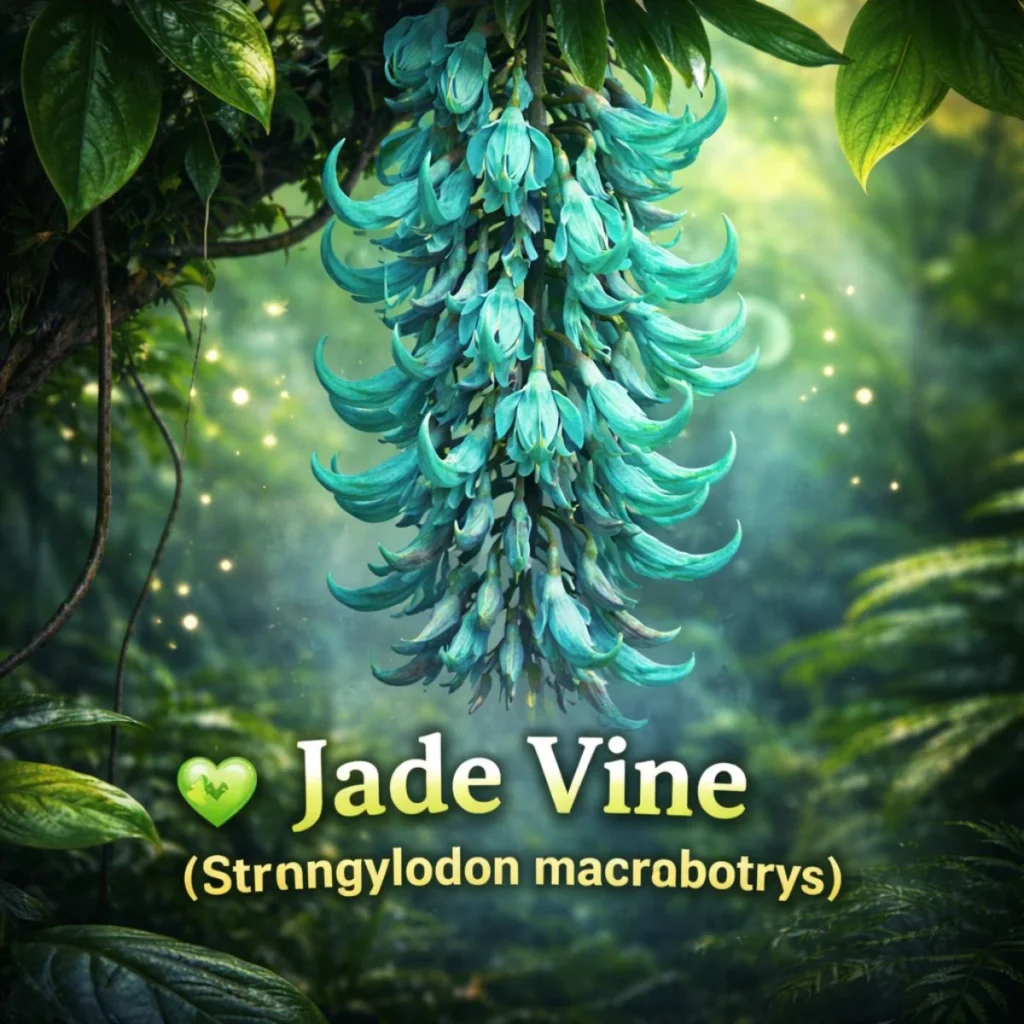
This Philippine native produces stunning turquoise flowers that look unnatural.
- Native to Philippines – found in Luzon, Mindoro, and Mindanao
- Flowers are jade green to turquoise blue – rare color for flowers
- Blooms hang in claw like clusters – up to 3 feet long
- Each cluster has 75 or more individual flowers – spectacular display
- Pollinated by bats – at night when flowers are most fragrant
- Flowers reflect ultraviolet light – bats can see this spectrum
- Listed as vulnerable species – habitat loss major threat
- Can grow 50 to 70 feet long – massive woody vine
- Leaves have three leaflets – typical of bean family
- Related to common garden beans – Fabaceae family
- Fruits are poisonous to humans – contain cyanide compounds
- Propagation by seed is difficult – seeds need scarification
- Cultivation requires high humidity – tropical conditions only
- Blooms in spring and early summer – April to June
- National flower of the Philippines? No. That is sampaguita. But close.
Parrot’s Beak (Lotus berthelotii) 🦜
This Canary Islands native has flowers shaped exactly like a parrot’s beak.
- Native to Canary Islands – specifically Tenerife, Gran Canaria, and Lanzarote
- Critically endangered in the wild – possibly extinct in nature
- Flowers are bright red to orange – shaped like curved beak
- Blooms from spring to summer – April through August
- Leaves are silver and needle like – covered in fine hairs
- Grows as trailing perennial – perfect for hanging baskets
- Pollinated by birds – sunbirds originally, now mostly by gardeners
- Requires full sun and well draining soil – very drought tolerant
- Tolerates coastal conditions – salt spray does not harm
- Can be grown from cuttings – seeds rarely available
- Hardy in zones 10 and 11 – needs protection from frost
- Flowers are sterile in cultivation – no seed production
- Rediscovered in wild in 2016 – thought extinct since 1884
- Named after French botanist Sabin Berthelot – studied Canary Islands
- Often called lotus vine or coral gem – in nursery trade
Kadupul Flower (Epiphyllum oxypetalum) 🌙
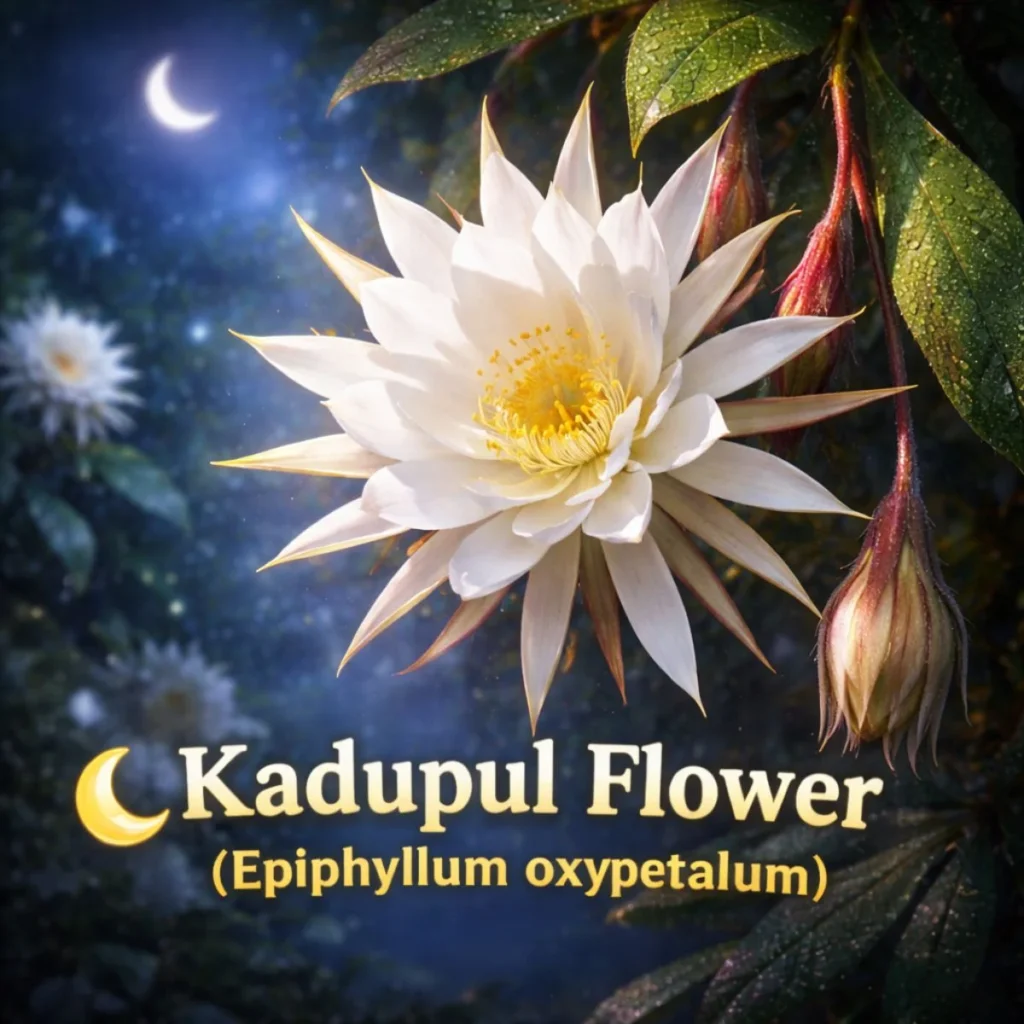
This night blooming cactus flower wilts within hours of opening. Also called queen of the night.
- Native to Central and South America – Mexico to Brazil
- Flowers open only at night – after 8 PM and before dawn
- White flowers are large and fragrant – up to 12 inches across
- Blooms last only one night – wilts by morning
- Flowers are sterile in cultivation – must be cross pollinated
- Scent is described as vanilla and jasmine – extremely strong
- Grows as epiphyte – on trees in nature, not in soil
- Flat leafless stems – photosynthesis happens in stems
- Requires bright indirect light – no direct afternoon sun
- Water when soil dries – prefers drying between waterings
- Blooms in late spring to early summer – May through July
- Individual plant may bloom multiple times – but not every year
- Considered flower of the gods in Sri Lanka – called kadupul mal
- Flower offered at Buddhist temples – represents impermanence
- Never cut for arrangements – wilts within hours anyway
Franklin Tree Flower (Franklinia alatamaha) 🌼
This tree is extinct in the wild. Every specimen descends from seeds collected in the 1700s.
- Discovered in 1765 along Altamaha River in Georgia – by John Bartram
- Named after Benjamin Franklin – Bartram’s close friend
- Last seen in wild in 1803 – extinct in nature since then
- All living trees descend from seeds collected by William Bartram
- White flowers have five petals – like camellia but smaller
- Flowers appear in late summer – July through September
- Bright yellow stamens in center – contrast with white petals
- Fragrant flowers smell like honeysuckle – sweet and light
- Tree grows 10 to 20 feet tall – occasionally to 30 feet
- Leaves turn bright red in autumn – spectacular fall color
- Prefers acidic, well draining soil – will not grow in clay
- Requires full sun to partial shade – best with morning sun
- Susceptible to root rot – cannot tolerate wet feet
- Rare in cultivation but available – from specialty nurseries
- State of Georgia’s rarest native plant – protected species
Corpse Flower (Amorphophallus titanum) ☠️
This Indonesian giant produces the largest unbranched inflorescence on Earth. It smells like rotting meat.
- Native to Sumatra, Indonesia – grows in rainforest clearings
- Flower can reach 10 feet tall – tallest on record was 12 feet
- Blooms only once every 7 to 10 years – unpredictable schedule
- Generates its own heat – up to 98 degrees Fahrenheit
- Heat helps spread smell – mimics freshly dead animal
- Smell described as rotting flesh, garbage, and sewage
- Pollinated by carrion beetles and flesh flies – attracted to odor
- Tuber can weigh over 150 pounds – size of large watermelon
- Leaf grows up to 20 feet tall – when not flowering
- Flower lasts only 24 to 48 hours – then collapses
- First cultivated bloom outside Sumatra – at Kew Gardens in 1889
- Thousands queue to see blooming events – worldwide attention
- Titan arum is another common name – means giant arum
- Conservation status is vulnerable – habitat loss threatens wild populations
- Cultivated plants are common – but blooming events are rare
Fire Lily (Gloriosa superba) 🔥
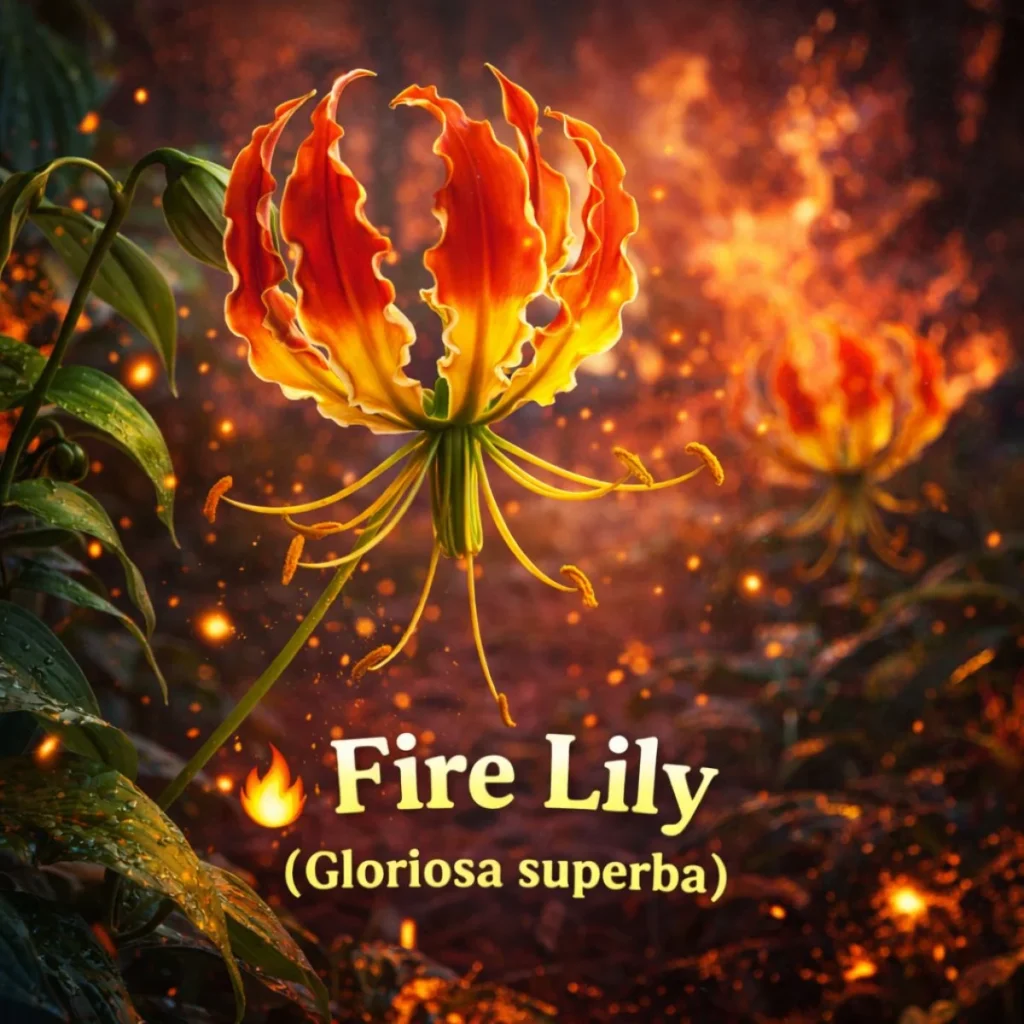
This climbing lily has flame shaped flowers that curl backward. Every part is poisonous.
- Native to Africa and Asia – from South Africa to India
- Flowers have six petals that curl backward – like flames
- Colors start yellow then turn red – from base to tip
- Blooms in summer and fall – June through October
- Leaves have tendrils at tips – help plant climb
- Can grow 6 to 8 feet tall – uses tendrils to grip
- All parts contain colchicine – same toxin as autumn crocus
- Ingesting any part can be fatal – even small amounts
- Used in traditional medicine – extremely dangerous practice
- National flower of Zimbabwe – also native to Tanzania
- Listed as invasive in some regions – Australia and Pacific islands
- Grows from tuberous roots – similar to sweet potato
- Propagation by division of tubers – seeds also work
- Requires well draining soil and full sun – drought tolerant once established
- Hardy in zones 8 to 11 – dies back in winter
Chocolate Cosmos (Cosmos atrosanguineus) 🍫
This Mexican flower smells exactly like chocolate. Its dark red color is rare among cosmos.
- Native to Mexico – discovered in 1850s
- Flowers are dark red to brownish black – almost black center
- Strong chocolate scent – vanillin compound causes smell
- Blooms from summer to fall – June through October
- Grows from tuberous roots – like dahlias
- Extinct in the wild – only cultivated plants exist
- All plants are clones of one original – no genetic diversity
- Flowers are sterile – no seed production
- Propagation only by dividing tubers – every plant identical
- Reaches 12 to 30 inches tall – compact growth habit
- Requires full sun and well draining soil – typical cosmos needs
- Hardy in zones 7 to 10 – needs winter mulch in colder zones
- Deadheading encourages more blooms – remove spent flowers
- Often sold as chocolate plant or black cosmos – in nursery trade
- First discovered in 1902 by botanist A. J. Cavanilles
Night Blooming Cereus (Selenicereus grandiflorus) 🌵
This cactus produces enormous fragrant flowers that open for one night only. Called queen of the night.
- Native to Caribbean, Central America, and Mexico – tropical regions
- Flowers can reach 12 inches across – huge for cactus
- White or cream colored petals – yellow stamens inside
- Opens after sunset – closes by mid morning
- Blooms only one night per flower – multiple flowers open over season
- Scent is sweet and intoxicating – compared to vanilla and gardenia
- Grows as climbing cactus – can reach 30 feet long
- Stems are thin and ribbed – resemble climbing vines
- Requires bright light but not direct sun – morning sun best
- Water regularly during growing season – less in winter
- Blooms in late spring to early summer – May through July
- Flowers must be cross pollinated – by moths in nature
- Fruit is edible – called dragon fruit or pitaya
- Related to commercially grown dragon fruit – same genus
- Name Selenicereus means moon cereus – from Selene, moon goddess
Rothschild’s Slipper Orchid (Paphiopedilum rothschildianum) 👡
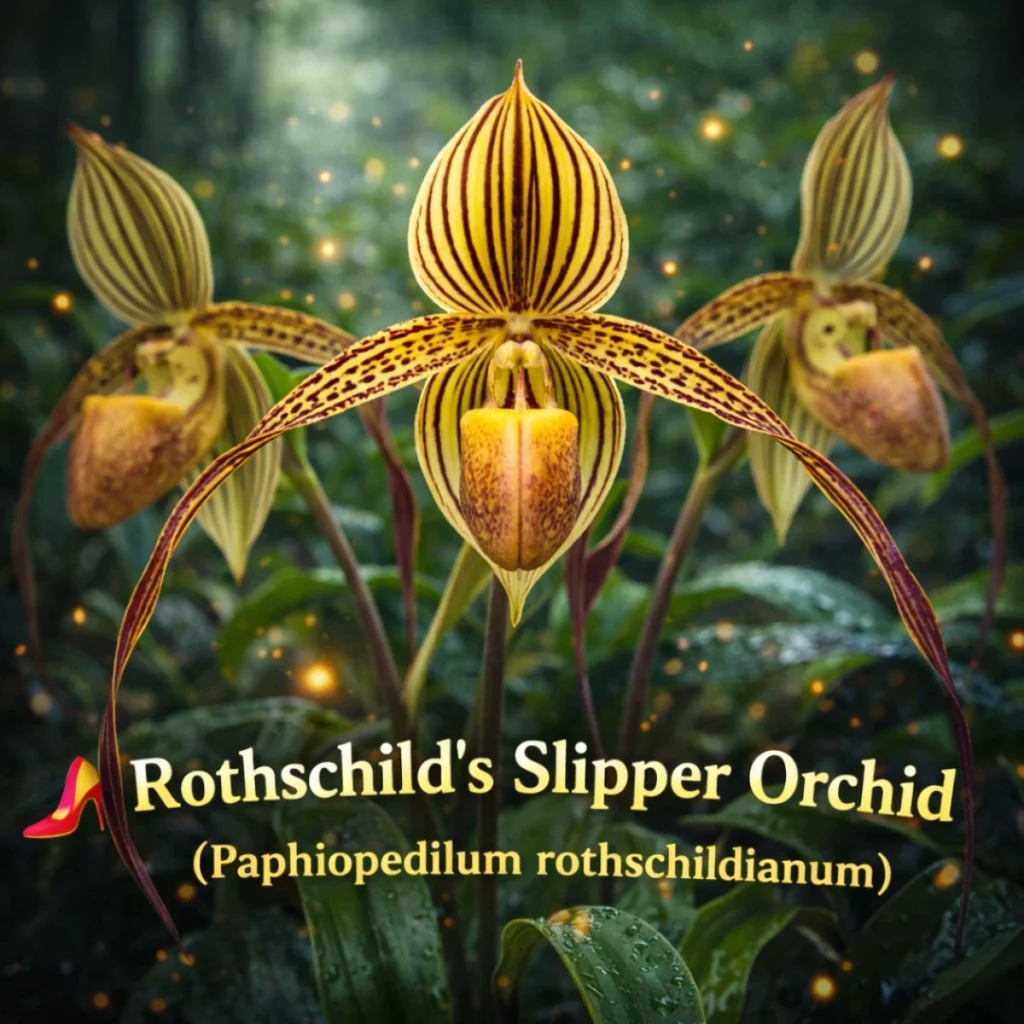
This orchid from Borneo has petals that can reach 3 feet long. It is one of the most expensive flowers in the world.
- Native to Mount Kinabalu in Borneo – specific elevation only
- Petals can grow 30 inches long – longer than most arms
- Flowers have slipper shaped pouch – typical of paphiopedilums
- Colors include green, purple, and yellow – striped patterns
- Single plant can cost thousands of dollars – up to $5000 per specimen
- Blooms in spring – April and May
- Listed as endangered – illegal collection major threat
- Grows on limestone cliffs – specific soil conditions required
- Discovered in 1887 – named after Baron Ferdinand de Rothschild
- Requires cool to intermediate temperatures – 60 to 75 degrees
- High humidity needed – 70 to 80 percent
- Very slow growing – years to reach flowering size
- One of the most sought after orchids – by collectors worldwide
- CITES Appendix I protected – international trade banned
- Cultivated plants available legally – from division of parent plants
Jade Goosefoot (Maihuenia patagonica) 💚
This rare cactus from Patagonia looks more like a succulent ground cover than a cactus.
- Native to Argentina and Chile – Patagonian steppe region
- Forms low mats of spiny stems – hugs the ground
- Yellow or green flowers – up to 2 inches across
- Blooms in late spring – November in Southern Hemisphere
- Can survive freezing temperatures – down to 5 degrees Fahrenheit
- Requires very well draining soil – gravelly sand preferred
- Needs full sun – becomes leggy in shade
- Water rarely – mimics desert conditions
- Slow growing plant – reaches maturity in many years
- Rare in cultivation – rarely offered for sale
- Seeds difficult to germinate – need cold stratification
- Related to common cacti – but looks completely different
- Name Maihuenia honors Maihuen – indigenous Mapuche name
- Species name patagonica means from Patagonia
- Discovered by French botanist Charles Antoine Lemaire – in 1840s
Snow Lotus (Saussurea gossipiphora) ❄️
This high altitude flower grows above 14,000 feet in the Himalayas. It has wooly white leaves for insulation.
- Native to Himalayas – from Pakistan to Bhutan
- Grows between 14,000 and 18,000 feet elevation – above treeline
- Leaves and flowers covered in white wool – gossypiphora means cotton bearing
- Wool protects from freezing temperatures and UV radiation
- Flowers are purple or blue – hidden inside wooly bracts
- Blooms in late summer – July and August
- Can take 7 years to flower – short growing season
- Used in traditional Tibetan medicine – called snow lotus
- Overharvested for medicine – conservation concern
- Difficult to cultivate – needs cold stratification
- Plants are small – only 2 to 6 inches tall
- Related to common sow thistle – same family Asteraceae
- Species name means cotton bearing – from Latin “gossypium” for cotton
- Discovered by Russian botanist Nikolai Turczaninow – in 1830s
- Considered sacred in some Buddhist traditions – symbol of purity
Pink Balloon Vine (Cardiospermum grandiflorum) 🎈
This tropical vine produces inflated seed pods that look like green balloons. Flowers are tiny and white.
- Native to South America – Argentina, Brazil, Uruguay
- Seed pods are green and papery – inflated like balloons
- Flowers are small and white – less than half inch across
- Blooms all year in warm climates – summer only in colder areas
- Vine can grow 30 feet in one season – extremely fast growing
- Leaves are compound with leaflets – typical of soapberry family
- Seeds have white heart shaped spots – cardiospermum means heart seed
- Invasive in some regions – Florida, South Africa, Hawaii
- Cultivated as ornamental for seed pods – flowers are insignificant
- Requires full sun and support – needs trellis or fence
- Tolerates poor soil – but prefers rich, well draining soil
- Propagation by seeds – which germinate easily
- Also called heart seed vine or love in a puff – English common names
- Pods contain three black seeds – each with white heart
- Named by Carl Linnaeus in 1753 – father of modern taxonomy
Frequently Asked Questions (FAQ) ❓
What is the rarest flower in the world?
Middlemist Red is often called the rarest. Only two living specimens exist. One grows in New Zealand. The other grows in England. Neither exists in the wild. 🌹
What flower blooms once every 100 years?
No flower blooms exactly every 100 years. The corpse flower blooms every 7 to 10 years. Some agave species bloom once after decades then die. The “century plant” actually blooms after 10 to 30 years. 🌸
What flower smells like chocolate?
Chocolate cosmos smells exactly like chocolate. The dark red flowers contain vanillin. That compound gives chocolate its scent. Extinct in the wild but available from nurseries. 🍫
What flower opens only at night?
Many flowers open only at night. The kadupul flower and night blooming cereus are famous examples. Both bloom after dark and wilt before morning. Moths and bats pollinate these species. 🌙
What is the most expensive flower in the world?
Rothschild’s slipper orchid is among the most expensive. A single plant can cost $5000. The Shenzhen Nongke orchid sold for over $200,000. That price was for development, not a single bloom. 💰
What flower is called ghost flower?
The ghost orchid is the most famous. Its white flowers appear to float in air. No leaves are visible. The green roots blend into tree bark. Only the flower seems to hover. 👻
What flower smells like rotting meat?
The corpse flower is the most famous. Its smell attracts carrion beetles and flesh flies. Other stinky flowers include rafflesia and some arums. Heat helps spread the odor. ☠️
Conclusion 🌺
Rare flower names open doors to discovery. They connect people to remote corners of the planet. Each name tells a story of exploration, adaptation, and survival. Some blooms exist in one location only. Others survive only in botanical gardens. A few are extinct in the wild and live on through human cultivation.
Learning these names is not just about memorizing words. It is about appreciating biodiversity. It is about understanding what is at risk. Many rare flowers face extinction from habitat loss, climate change, and illegal collection. Each lost species reduces the world’s beauty.
Whether you grow them or just admire them, rare flowers remind us how precious nature is. A flower that blooms one night per year. A plant that smells like chocolate. An orchid with petals longer than a person’s arm. These are the wonders worth protecting. 🌸💙🌺

Michael Harris is a content writer at NamelyHub, where he shares creative and unique name ideas for every purpose. With a strong interest in branding and modern naming trends, he creates helpful collections of names for pets, teams, businesses, and more.
His goal is to make finding the perfect name simple, inspiring, and accessible for everyone.