
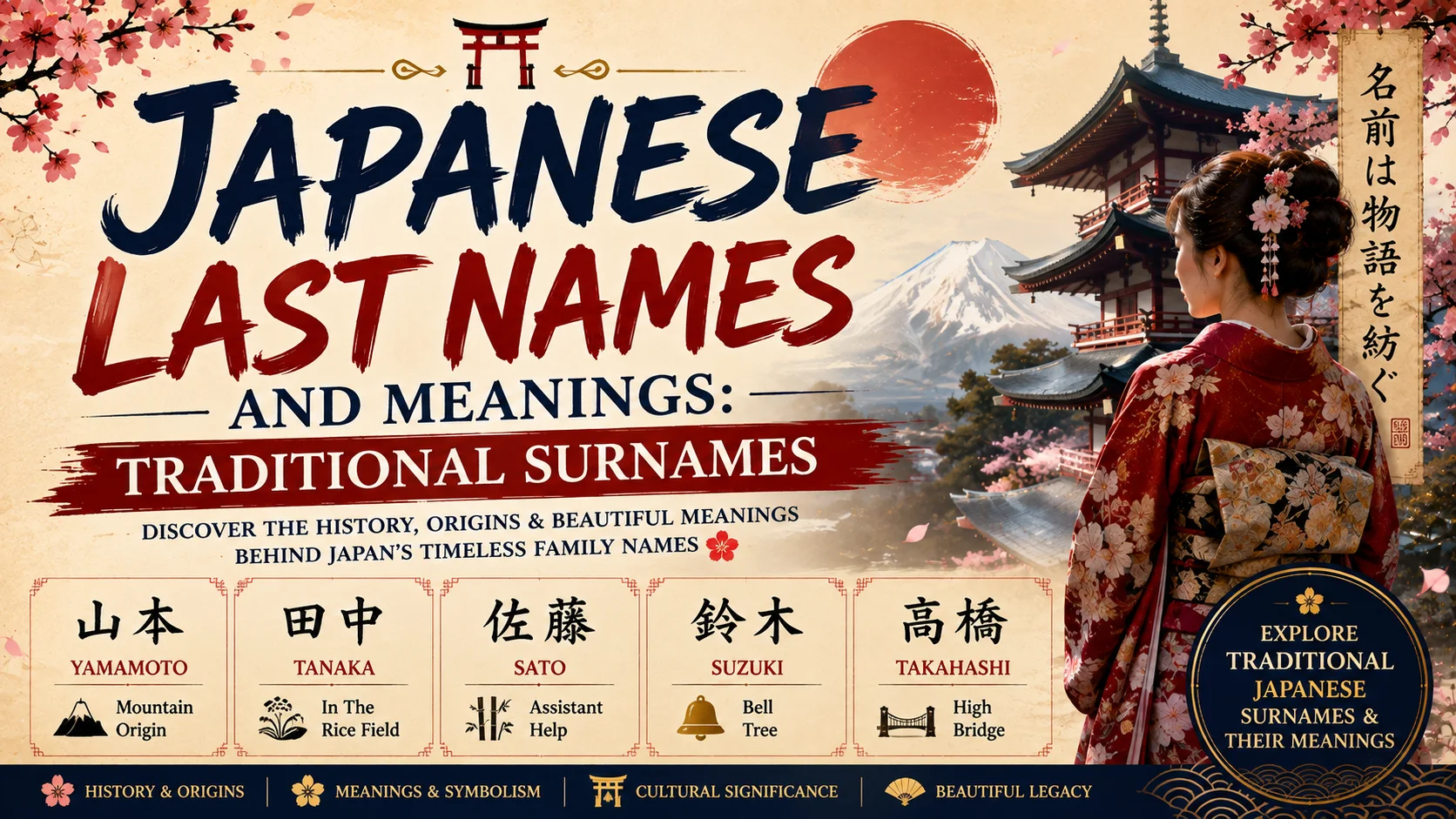
Japanese surnames are deeply connected to nature, geography, history, family heritage, and traditional Japanese culture. Many Japanese family names contain kanji characters associated with mountains, rivers, forests, fields, flowers, villages, seasons, and places. This gives them a distinctive quality that makes them popular not only in Japan but also among writers, gamers, anime fans, and anyone searching for meaningful character names.
A Japanese surname can tell a small story. Yamamoto, for example, contains characters associated with a mountain and its base, while Kawamura combines ideas connected with a river and village. Names such as Sakura, Mori, and Takahashi also have strong visual or geographical associations.
However, Japanese surname meanings can be more complicated than a simple English translation. The same pronunciation may be written with different kanji, and the meaning can change depending on those characters. Some family names also originated from particular places or historical circumstances rather than having a literal meaning.
In this guide, you’ll find Japanese last names and meanings, including traditional surnames, nature-inspired family names, beautiful Japanese surnames, rare choices, common names, anime-friendly surnames, and names with their kanji-based meanings. 🇯🇵✨
🌸 How Japanese Last Names Work
Japanese surnames are generally written before the given name. For example, Sato Haruki places the family name first and the personal name second, following the traditional Japanese naming order.
Most Japanese surnames are written using kanji. A single kanji can represent an idea, object, place, or natural feature, and surnames often combine two or more characters.
For example:
- Yama (山) — mountain
- Kawa (川) — river
- Mori (森) — forest
- Hana (花) — flower
- Sato (佐藤) — a surname traditionally written with the characters 佐 and 藤
- Hashi (橋) — bridge
- Tanaka (田中) — middle of the rice field
This is why Japanese surname meanings can be especially interesting for fictional characters. The kanji can contribute symbolism even when the literal interpretation isn’t the historical origin of the family name.
Some surnames also have multiple possible kanji spellings. Therefore, a surname’s meaning should be treated as the meaning of a particular written form rather than assuming every person with the same pronunciation has the same interpretation.
🇯🇵 Common Japanese Last Names
These are some of the most recognizable Japanese family names, common Japanese surnames, traditional surnames, and Japanese heritage names.
- Sato — 佐藤
- Suzuki — 鈴木
- Takahashi — 高橋
- Tanaka — 田中
- Watanabe — 渡辺
- Ito — 伊藤
- Yamamoto — 山本
- Nakamura — 中村
- Kobayashi — 小林
- Kato — 加藤
- Yoshida — 吉田
- Yamada — 山田
- Sasaki — 佐々木
- Yamaguchi — 山口
- Saito — 斎藤
- Matsumoto — 松本
- Inoue — 井上
- Kimura — 木村
- Hayashi — 林
- Shimizu — 清水
- Yamazaki — 山崎
- Mori — 森
- Abe — 阿部
- Ikeda — 池田
- Hashimoto — 橋本
- Ishikawa — 石川
- Maeda — 前田
- Fujita — 藤田
- Ogawa — 小川
- Goto — 後藤
- Okada — 岡田
- Hasegawa — 長谷川
- Murakami — 村上
- Kondo — 近藤
- Ishii — 石井
- Sakamoto — 坂本
- Endo — 遠藤
- Aoki — 青木
- Fujii — 藤井
- Nishimura — 西村
- Fukuda — 福田
- Ota — 太田
- Miura — 三浦
- Fujiwara — 藤原
- Okamoto — 岡本
- Matsuda — 松田
- Nakagawa — 中川
- Nakajima — 中島
- Harada — 原田
- Ono — 小野
🌿 Japanese Last Names Inspired by Nature
Nature plays a major role in Japanese surname imagery. Nature-inspired Japanese surnames, Japanese family names, botanical surnames, and landscape names can evoke forests, mountains, rivers, trees, and fields.
- Mori — 森 — forest
- Hayashi — 林 — woods or grove
- Yamamoto — 山本 — base of the mountain
- Yamaguchi — 山口 — mountain entrance
- Yamada — 山田 — mountain rice field
- Tanaka — 田中 — middle of the rice field
- Ogawa — 小川 — small river
- Ishikawa — 石川 — stone river
- Aoki — 青木 — green or blue tree
- Matsuda — 松田 — pine field
- Matsumoto — 松本 — base of the pine
- Kimura — 木村 — tree village
- Takagi — 高木 — tall tree
- Kishi — 岸 — shore or bank
- Kawamura — 川村 — river village
- Kawakami — 川上 — upper river
- Kawashima — 川島 — river island
- Nakagawa — 中川 — middle river
- Fujimoto — 藤本 — base of the wisteria
- Fujita — 藤田 — wisteria field
- Fujii — 藤井 — wisteria well
- Sakurai — 桜井 — cherry-blossom well
- Hanazawa — 花沢 — flower marsh
- Hanamura — 花村 — flower village
- Umeda — 梅田 — plum field
- Ueno — 上野 — upper field
- Nakano — 中野 — middle field
- Nishino — 西野 — western field
- Higashino — 東野 — eastern field
- Harada — 原田 — field/plain rice field
🌸 Beautiful Japanese Last Names
Some surnames have an especially elegant appearance or evoke beautiful natural imagery. These beautiful Japanese surnames, aesthetic Japanese last names, elegant family names, and soft-sounding surnames can work well for characters and creative writing.
- Sakurai — 桜井 — cherry-blossom well
- Hanamura — 花村 — flower village
- Fujimoto — 藤本 — base of the wisteria
- Fujikawa — 藤川 — wisteria river
- Mizuno — 水野 — water field
- Shimizu — 清水 — clear water
- Takahashi — 高橋 — high bridge
- Hoshino — 星野 — star field
- Tsukino — 月野 — moon field
- Amamiya — 雨宮 — rain shrine
- Aoyama — 青山 — blue or green mountain
- Moriyama — 森山 — forest mountain
- Kawamura — 川村 — river village
- Nishikawa — 西川 — western river
- Asano — 浅野 — shallow field
- Komori — 小森 — small forest
- Kinoshita — 木下 — beneath the tree
- Tachibana — 橘 — tachibana citrus tree
- Shiraishi — 白石 — white stone
- Ishida — 石田 — stone field
- Hoshikawa — 星川 — star river
- Hanazono — 花園 — flower garden
- Kawabata — 川端 — riverside
- Minami — 南 — south
- Arai — 新井 — new well
⛰️ Japanese Last Names Related to Mountains
Mountains are important geographical features throughout Japan, so many surnames contain the kanji 山 (yama) or relate to mountainous locations. These mountain-inspired Japanese surnames, geographical family names, and Japanese nature names have a strong, grounded feeling.
- Yamamoto — 山本 — base of the mountain
- Yamada — 山田 — mountain rice field
- Yamaguchi — 山口 — mountain entrance
- Yamashita — 山下 — below the mountain
- Yamanaka — 山中 — within the mountain
- Yamazaki — 山崎 — mountain cape
- Yamashiro — 山城 — mountain castle
- Yamagishi — 山岸 — mountain shore
- Aoyama — 青山 — blue or green mountain
- Moriyama — 森山 — forest mountain
- Takayama — 高山 — high mountain
- Nakayama — 中山 — middle mountain
- Nishiyama — 西山 — western mountain
- Higashiyama — 東山 — eastern mountain
- Kitayama — 北山 — northern mountain
- Minamiyama — 南山 — southern mountain
- Okuyama — 奥山 — inner mountain
- Matsuyama — 松山 — pine mountain
- Ishiyama — 石山 — stone mountain
- Koyama — 小山 — small mountain
- Oyamamoto — 大山本 — great mountain base
- Fujiyama — 富士山 — Mount Fuji
- Hoshiyama — 星山 — star mountain
- Tsukiyama — 月山 — moon mountain
- Kanayama — 金山 — gold mountain
🌊 Japanese Last Names Related to Water
Water imagery appears frequently in Japanese surnames. These water-inspired surnames, river names, Japanese nature names, and geographical family names are ideal for characters connected with rivers, lakes, rain, or the sea.
- Shimizu — 清水 — clear water
- Mizuno — 水野 — water field
- Mizutani — 水谷 — water valley
- Mizukawa — 水川 — water river
- Kawamura — 川村 — river village
- Kawakami — 川上 — upper river
- Kawashima — 川島 — river island
- Kawabata — 川端 — riverside
- Nakagawa — 中川 — middle river
- Nishikawa — 西川 — western river
- Ishikawa — 石川 — stone river
- Ogawa — 小川 — small river
- Arakawa — 荒川 — wild river
- Kagawa — 香川 — fragrant river
- Aikawa — 相川 — meeting river
- Hoshikawa — 星川 — star river
- Tsukikawa — 月川 — moon river
- Yukikawa — 雪川 — snow river
- Amano — 天野 — heavenly field
- Amamiya — 雨宮 — rain shrine
- Amakawa — 天川 — heavenly river
- Umino — 海野 — sea field
- Umemura — 梅村 — plum village
- Kaikawa — 海川 — sea river
- Hamada — 浜田 — beach field
🌳 Japanese Last Names Related to Trees and Forests
Japanese surnames often contain characters associated with trees and wooded landscapes. These forest-inspired Japanese surnames, tree names, botanical family names, and nature surnames feel earthy and traditional.
- Mori — 森 — forest
- Hayashi — 林 — woods
- Kimura — 木村 — tree village
- Kinoshita — 木下 — beneath the tree
- Takagi — 高木 — tall tree
- Aoki — 青木 — green tree
- Matsuda — 松田 — pine field
- Matsumoto — 松本 — base of the pine
- Matsui — 松井 — pine well
- Matsuzaki — 松崎 — pine cape
- Matsumura — 松村 — pine village
- Fujimoto — 藤本 — wisteria base
- Fujita — 藤田 — wisteria field
- Fujii — 藤井 — wisteria well
- Fujiwara — 藤原 — wisteria plain
- Tachibana — 橘 — tachibana citrus tree
- Umezaki — 梅崎 — plum cape
- Umeda — 梅田 — plum field
- Umehara — 梅原 — plum plain
- Takeuchi — 竹内 — inside the bamboo
- Takemoto — 竹本 — base of bamboo
- Takeuchi — 竹内 — bamboo interior
- Morita — 森田 — forest field
- Morimoto — 森本 — base of forest
- Morikawa — 森川 — forest river
🌾 Japanese Last Names Related to Fields and Villages
Agriculture and rural geography have influenced many Japanese surnames. These Japanese rural surnames, field names, village names, traditional family names, and agricultural surnames have a distinctly old-world feeling.
- Tanaka — 田中 — middle of the rice field
- Yamada — 山田 — mountain rice field
- Yoshida — 吉田 — fortunate rice field
- Ikeda — 池田 — pond field
- Maeda — 前田 — front field
- Fujita — 藤田 — wisteria field
- Matsuda — 松田 — pine field
- Okada — 岡田 — hill field
- Harada — 原田 — plain field
- Nishida — 西田 — western field
- Higashida — 東田 — eastern field
- Minamida — 南田 — southern field
- Kitada — 北田 — northern field
- Ueda — 上田 — upper field
- Nakada — 中田 — middle field
- Shimada — 島田 — island field
- Murata — 村田 — village field
- Kida — 木田 — tree field
- Oda — 小田 — small field
- Handa — 半田 — half field
- Hara — 原 — plain or field
- Noda — 野田 — field
- Noguchi — 野口 — field entrance
- Nomura — 野村 — field village
- Nakano — 中野 — middle field
🌙 Japanese Last Names With a Mystical Feel
Some surnames have a poetic or atmospheric quality, especially those associated with stars, moonlight, rain, flowers, mountains, and unusual natural imagery. These mystical Japanese surnames, poetic family names, fantasy Japanese names, and aesthetic surnames are excellent for fictional characters.
- Hoshino — 星野 — star field
- Hoshikawa — 星川 — star river
- Tsukino — 月野 — moon field
- Tsukikawa — 月川 — moon river
- Amamiya — 雨宮 — rain shrine
- Amano — 天野 — heavenly field
- Amakawa — 天川 — heavenly river
- Sakurai — 桜井 — cherry-blossom well
- Hanazono — 花園 — flower garden
- Hanamura — 花村 — flower village
- Fujimoto — 藤本 — wisteria base
- Shimizu — 清水 — clear water
- Mizuno — 水野 — water field
- Aoyama — 青山 — blue or green mountain
- Moriyama — 森山 — forest mountain
- Yukimura — 雪村 — snow village
- Yukikawa — 雪川 — snow river
- Kazama — 風間 — space between winds
- Kaze — 風 — wind
- Asahi — 朝日 — morning sun
- Hinata — 日向 — sunny place
- Hikari — 光 — light
- Akabane — 赤羽 — red feather
- Shiroyama — 白山 — white mountain
- Kurokawa — 黒川 — black river
⚔️ Strong Japanese Last Names
If you’re naming a warrior, samurai-inspired character, hero, or powerful fictional figure, these strong Japanese surnames, samurai names, warrior family names, historical surnames, and powerful character names can work well.
- Takahashi — 高橋 — high bridge
- Takayama — 高山 — high mountain
- Ishikawa — 石川 — stone river
- Ishida — 石田 — stone field
- Iwamoto — 岩本 — base of the rock
- Iwata — 岩田 — rock field
- Matsumoto — 松本 — pine base
- Yamamoto — 山本 — mountain base
- Yamashita — 山下 — below the mountain
- Yamazaki — 山崎 — mountain cape
- Sakai — 境 — boundary
- Sakurai — 桜井 — cherry-blossom well
- Kuroda — 黒田 — black field
- Kurokawa — 黒川 — black river
- Shiraishi — 白石 — white stone
- Okamoto — 岡本 — base of the hill
- Okada — 岡田 — hill field
- Maeda — 前田 — front field
- Sakamoto — 坂本 — base of the slope
- Sakaguchi — 坂口 — slope entrance
- Arakawa — 荒川 — wild river
- Araki — 荒木 — wild tree
- Nagata — 永田 — eternal field
- Nagasaki — 長崎 — long cape
- Kanda — 神田 — divine field
🌺 Japanese Last Names Inspired by Flowers
Flowers and plants offer some of the most visually beautiful surname imagery. These floral Japanese surnames, botanical family names, flower-inspired names, and Japanese nature surnames can create a gentle aesthetic.
- Sakurai — 桜井 — cherry-blossom well
- Sakura — 桜 — cherry blossom
- Fujimoto — 藤本 — wisteria base
- Fujita — 藤田 — wisteria field
- Fujii — 藤井 — wisteria well
- Fujiwara — 藤原 — wisteria plain
- Hanazono — 花園 — flower garden
- Hanamura — 花村 — flower village
- Hanada — 花田 — flower field
- Hanabusa — 英 — flower-like association in some usages
- Umeda — 梅田 — plum field
- Umehara — 梅原 — plum plain
- Umezaki — 梅崎 — plum cape
- Tachibana — 橘 — tachibana citrus
- Kikuchi — 菊池 — chrysanthemum pond
- Kikuchi — 菊地 — chrysanthemum land
- Aoi — 葵 — hollyhock
- Ayame — 菖蒲 — iris
- Fuji — 藤 — wisteria
- Sakuraoka — 桜岡 — cherry-blossom hill
- Sakurada — 桜田 — cherry-blossom field
- Sakuraba — 桜庭 — cherry-blossom garden
- Fujisawa — 藤沢 — wisteria marsh
- Fujikawa — 藤川 — wisteria river
- Fujimori — 藤森 — wisteria forest
🏯 Traditional Japanese Last Names
Traditional surnames are excellent for historical fiction, Japanese characters, family names, and stories set in older periods. These traditional Japanese surnames, heritage names, historical family names, and classic Japanese last names have a timeless quality.
- Fujiwara — 藤原
- Minamoto — 源
- Taira — 平
- Tachibana — 橘
- Sugawara — 菅原
- Abe — 安倍
- Kiyohara — 清原
- Nakahara — 中原
- Watanabe — 渡辺
- Hasegawa — 長谷川
- Yamamoto — 山本
- Takahashi — 高橋
- Tanaka — 田中
- Nakamura — 中村
- Yoshida — 吉田
- Yamada — 山田
- Mori — 森
- Hayashi — 林
- Saito — 斎藤
- Kato — 加藤
- Ito — 伊藤
- Goto — 後藤
- Inoue — 井上
- Matsuda — 松田
- Okamoto — 岡本
- Ishikawa — 石川
- Maeda — 前田
- Sakurai — 桜井
- Aoyama — 青山
- Shimizu — 清水
👑 Japanese Last Names That Sound Elegant
If you’re choosing a surname for a fictional character, elegance can come from the pronunciation as well as the kanji imagery. These elegant Japanese surnames, sophisticated family names, aesthetic Japanese names, and refined surnames are especially attractive.
- Fujimori — 藤森
- Fujisawa — 藤沢
- Sakurai — 桜井
- Hoshino — 星野
- Amamiya — 雨宮
- Shimizu — 清水
- Mizuno — 水野
- Aoyama — 青山
- Moriyama — 森山
- Takahashi — 高橋
- Hanazono — 花園
- Kawamura — 川村
- Nishikawa — 西川
- Tachibana — 橘
- Asano — 浅野
- Ishikawa — 石川
- Hasegawa — 長谷川
- Fujikawa — 藤川
- Matsumoto — 松本
- Kamiyama — 神山
- Tsukino — 月野
- Hoshikawa — 星川
- Kazama — 風間
- Shiraishi — 白石
- Yukimura — 雪村
- Morimoto — 森本
- Kinoshita — 木下
- Mizutani — 水谷
- Kawabata — 川端
- Uehara — 上原
🌑 Rare & Unique Japanese Last Names
Some surnames are less familiar internationally and can give fictional characters a distinctive identity. These unique Japanese surnames, uncommon family names, rare Japanese last names, and character surnames offer a less predictable style.
- Amamiya — 雨宮
- Hoshino — 星野
- Kazama — 風間
- Hanazono — 花園
- Tsukino — 月野
- Yukimura — 雪村
- Fujimori — 藤森
- Fujisawa — 藤沢
- Kamiyama — 神山
- Shiroyama — 白山
- Kurokawa — 黒川
- Akabane — 赤羽
- Hoshikawa — 星川
- Mizutani — 水谷
- Kawabata — 川端
- Kinoshita — 木下
- Morimoto — 森本
- Uehara — 上原
- Arakawa — 荒川
- Sakuraba — 桜庭
- Sakuragi — 桜木
- Hanamura — 花村
- Fujikawa — 藤川
- Umezaki — 梅崎
- Tachibana — 橘
- Kanda — 神田
- Kaneko — 金子
- Kanayama — 金山
- Hoshizaki — 星崎
- Tsukahara — 塚原
- Amakawa — 天川
- Mizukawa — 水川
- Aoyagi — 青柳
- Shirakawa — 白川
- Kurosawa — 黒沢
- Akagawa — 赤川
- Shibasaki — 柴崎
- Morikawa — 森川
- Iwamoto — 岩本
- Takashima — 高島
🎌 Japanese Last Names for Anime Characters
Anime and manga characters often have surnames that are memorable, easy to pronounce, and visually distinctive. These Japanese anime surnames, manga character names, fictional Japanese family names, and character naming ideas can help when creating original characters.
- Akiyama — 秋山 — autumn mountain
- Aoyama — 青山 — blue or green mountain
- Amamiya — 雨宮 — rain shrine
- Arakawa — 荒川 — wild river
- Fujimoto — 藤本 — wisteria base
- Fujisawa — 藤沢 — wisteria marsh
- Hasegawa — 長谷川 — long valley river
- Hoshino — 星野 — star field
- Ishikawa — 石川 — stone river
- Kamiyama — 神山 — divine mountain
- Kawamura — 川村 — river village
- Kinoshita — 木下 — beneath the tree
- Kurokawa — 黒川 — black river
- Mizuno — 水野 — water field
- Moriyama — 森山 — forest mountain
- Nishikawa — 西川 — western river
- Sakurai — 桜井 — cherry-blossom well
- Sakuragi — 桜木 — cherry tree
- Shimizu — 清水 — clear water
- Shiraishi — 白石 — white stone
- Takahashi — 高橋 — high bridge
- Tsukino — 月野 — moon field
- Uehara — 上原 — upper plain
- Watanabe — 渡辺 — crossing area
- Yamamoto — 山本 — mountain base
- Yamaguchi — 山口 — mountain entrance
- Yuki — 雪 — snow in some surname spellings
- Yukimura — 雪村 — snow village
- Kazama — 風間 — space between winds
- Hoshikawa — 星川 — star river
🧑🎓 Japanese Last Names for Characters
When creating an original character, think about personality before choosing the surname. A quiet character might suit Shimizu or Hoshino, while a strong warrior might fit Ishikawa or Takayama.
- Akiyama — autumn mountain
- Aoyama — blue or green mountain
- Amamiya — rain shrine
- Asano — shallow field
- Fujimoto — wisteria base
- Hoshino — star field
- Ishikawa — stone river
- Kamiyama — divine mountain
- Kawamura — river village
- Kinoshita — beneath the tree
- Kurokawa — black river
- Mizuno — water field
- Moriyama — forest mountain
- Nishikawa — western river
- Sakurai — cherry-blossom well
- Shimizu — clear water
- Shiraishi — white stone
- Takahashi — high bridge
- Tsukino — moon field
- Uehara — upper plain
- Watanabe — crossing area
- Yamamoto — mountain base
- Yamaguchi — mountain entrance
- Yukimura — snow village
- Kazama — wind space
- Hoshikawa — star river
- Fujisawa — wisteria marsh
- Hanazono — flower garden
- Kawabata — riverside
- Morimoto — forest base
🌿 Japanese Last Names With Simple Meanings
If you want a surname with an easy-to-understand literal association, these choices are particularly accessible. These Japanese surnames with meanings, simple Japanese family names, nature surnames, and meaningful character names are useful for beginners.
- Mori — 森 — forest
- Hayashi — 林 — woods
- Ogawa — 小川 — small river
- Shimizu — 清水 — clear water
- Mizuno — 水野 — water field
- Tanaka — 田中 — middle of the rice field
- Yamamoto — 山本 — mountain base
- Yamaguchi — 山口 — mountain entrance
- Takayama — 高山 — high mountain
- Aoyama — 青山 — blue or green mountain
- Ishikawa — 石川 — stone river
- Shiraishi — 白石 — white stone
- Kinoshita — 木下 — beneath the tree
- Takagi — 高木 — tall tree
- Matsuda — 松田 — pine field
- Umeda — 梅田 — plum field
- Hanazono — 花園 — flower garden
- Kawamura — 川村 — river village
- Kawakami — 川上 — upper river
- Kawabata — 川端 — riverside
- Hoshino — 星野 — star field
- Tsukino — 月野 — moon field
- Yukimura — 雪村 — snow village
- Kazama — 風間 — space between winds
- Asahi — 朝日 — morning sun
- Hinata — 日向 — sunny place
- Sakurai — 桜井 — cherry-blossom well
- Hanada — 花田 — flower field
- Nishino — 西野 — western field
- Nakano — 中野 — middle field
📝 How to Choose a Japanese Last Name
Choosing a Japanese surname for a character or creative project becomes easier when you consider meaning, kanji, pronunciation, personality, setting, and historical context.
If you want a nature-based character, surnames such as Mori, Hayashi, Aoyama, Hoshino, Shimizu, or Sakurai can work beautifully. Their imagery connects with forests, mountains, stars, water, and flowers.
For a strong character, consider names associated with mountains and stones, such as Takayama, Yamamoto, Ishikawa, Iwamoto, or Shiraishi.
For a gentle or elegant character, surnames such as Fujisawa, Sakurai, Hanazono, Hoshino, Amamiya, and Mizuno offer a softer atmosphere. 🌸
It’s also important to remember that kanji matters. Two surnames can have the same romanized pronunciation but completely different written forms and meanings. If you’re using a Japanese surname for a serious story, historical project, or real-world context, verify the exact kanji rather than relying solely on an English translation.
For fictional characters, however, you can use the imagery of the kanji as inspiration. A character called Hoshino can evoke stars and open skies, while Kurokawa can create a darker association through its “black river” imagery.
❓ FAQs About Japanese Last Names
What are common Japanese last names?
Some widely recognized Japanese surnames include Sato, Suzuki, Takahashi, Tanaka, Watanabe, Ito, Yamamoto, Nakamura, Kobayashi, and Kato.
What Japanese last name means forest?
Mori (森) means “forest,” while Hayashi (林) means “woods” or “grove.” Both are associated with trees and wooded landscapes.
What Japanese last name means mountain?
Several surnames contain 山, meaning “mountain.” Examples include Yamamoto, Yamada, Yamaguchi, Takayama, Nakayama, and Aoyama.
What Japanese surname means river?
Several surnames contain 川, meaning “river.” Examples include Ogawa, Ishikawa, Kawamura, Kawakami, Kawashima, and Nakagawa.
What Japanese last name means flower?
Some Japanese surnames contain 花, meaning “flower.” Examples include Hanazono, Hanamura, and Hanada.
What Japanese surname means cherry blossom?
Sakura refers to cherry blossoms, while surnames such as Sakurai, Sakuragi, and Sakurada incorporate cherry-blossom-related kanji.
What Japanese last name means star?
Hoshino (星野) can be interpreted from its kanji as “star field,” while Hoshikawa (星川) combines “star” and “river.”
What Japanese last name means moon?
Tsukino (月野) combines 月, meaning “moon,” with 野, meaning “field.” The exact historical surname meaning can depend on the family’s kanji and origin.
Are Japanese surnames always two kanji?
No. Many Japanese surnames use two kanji, but surnames can have one, three, or more characters. Different families can also use different kanji for the same pronunciation.
Do Japanese surnames have literal meanings?
Many can be interpreted through their kanji, especially names based on geographical features. However, the literal kanji meaning isn’t always the same as the historical origin of the family name.
What are beautiful Japanese surnames?
Some aesthetically appealing choices include Sakurai, Hoshino, Amamiya, Fujisawa, Hanazono, Shimizu, Mizuno, and Aoyama.
What are good Japanese surnames for fictional characters?
Popular choices for fictional characters include Hoshino, Amamiya, Sakurai, Aoyama, Fujimoto, Mizuno, Kurokawa, Kawamura, and Yukimura.
🌸 Conclusion
Japanese last names offer an enormous range of meanings and imagery. Many are connected to the natural world, including mountains, rivers, forests, flowers, fields, trees, stars, water, and weather. This makes them especially appealing when you want a family name with a visual or symbolic quality.
Common surnames such as Sato, Suzuki, Takahashi, Tanaka, Yamamoto, Nakamura, and Watanabe have a strong connection with Japanese naming culture. Nature-focused options such as Mori, Hayashi, Hoshino, Shimizu, Sakurai, Aoyama, and Kawamura offer beautiful imagery. 🇯🇵
For fictional characters, you can choose a surname according to personality. Ishikawa or Takayama can suit a strong character, while Hoshino or Sakurai can create a softer aesthetic. Darker characters might suit names such as Kurokawa, while mysterious characters could use Amamiya or Tsukino.
Remember that Japanese surname meanings depend heavily on the kanji spelling. A romanized name can have multiple possible written forms, so the pronunciation alone doesn’t always tell you its exact meaning.
Whether you’re writing an anime-inspired story, creating an RPG character, researching Japanese family names, or simply looking for a beautiful surname, the right combination of sound, kanji, meaning, and cultural context can make a name much more memorable. 🌸🇯🇵

Michael Harris is a content writer at NamelyHub, where he shares creative and unique name ideas for every purpose. With a strong interest in branding and modern naming trends, he creates helpful collections of names for pets, teams, businesses, and more.
His goal is to make finding the perfect name simple, inspiring, and accessible for everyone.