
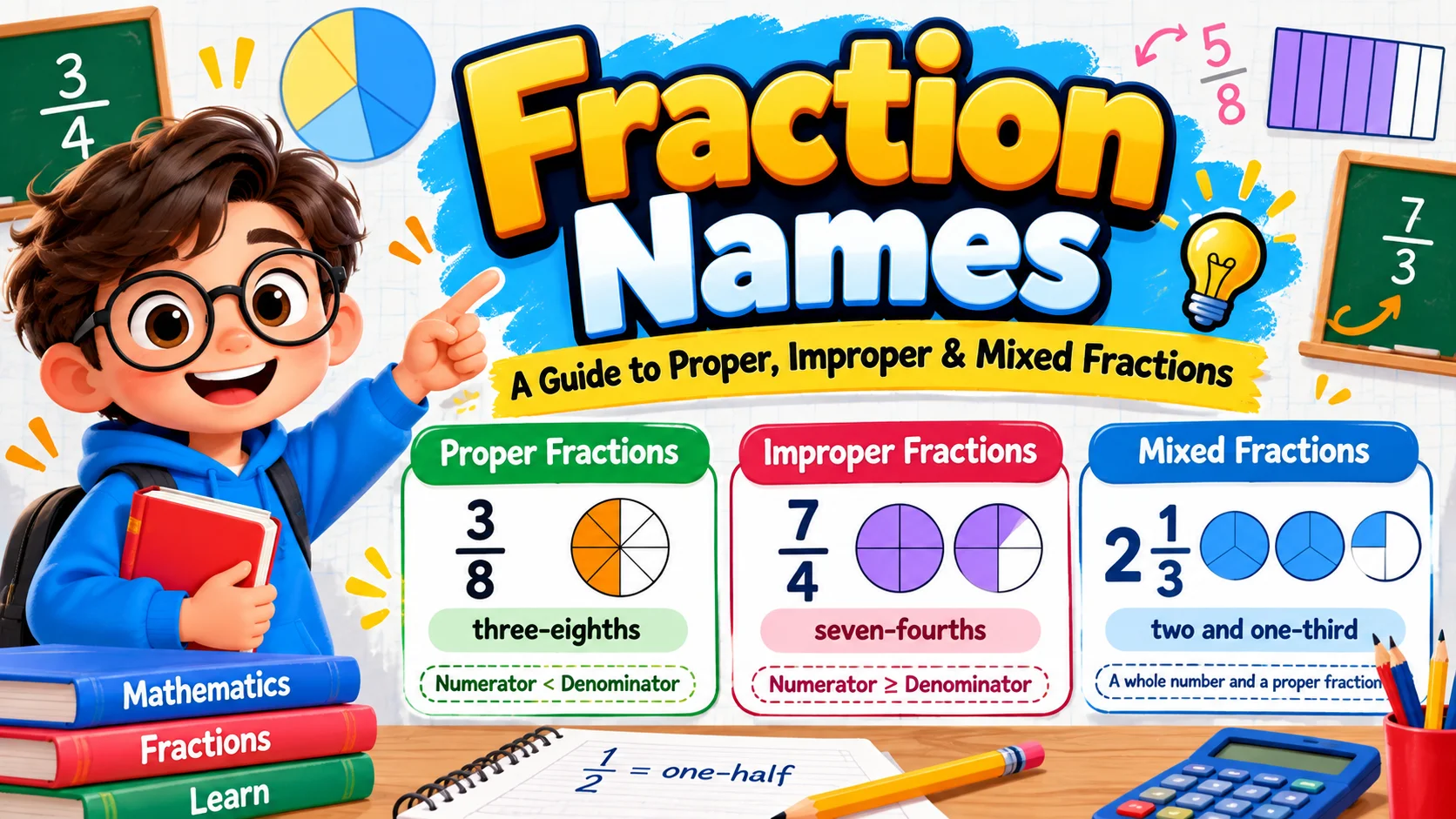
Fractions are one of the most important parts of basic mathematics because they help us describe portions, parts, and quantities that are smaller than or greater than one whole. From one-half of a pizza to three-quarters of an hour, fractions appear in everyday situations as well as in school mathematics.
Understanding fraction names makes fractions easier to read, write, compare, and use in calculations. Instead of looking at a fraction such as 3/8 as only two numbers separated by a line, you can recognize it as three-eighths and understand what the numerator and denominator represent.
Whether you are learning fractions for the first time, helping a child with math homework, or reviewing fraction vocabulary, this guide explains common fraction names in simple language. You will learn how to read fractions, name proper and improper fractions, understand mixed numbers, and recognize common fractional values.
🔢 What Are Fraction Names?
Fraction names are the words we use to read and describe fractions. For example, 1/2 is call one-half, 1/3 is called one-third, and 3/4 is called three-fourths.
A fraction has two main parts: the numerator, which appears on top, and the denominator, which appears on the bottom. The numerator tells us how many parts are being considered, while the denominator tells us how many equal parts make up one whole.
For example, in 3/5, the 3 is the numerator and the 5 is the denominator. We read the fraction as three-fifths, meaning three parts out of five equal parts.
Knowing these names helps students connect mathematical symbols with mathematical language.
📚 Common Fraction Names from 1 to 20
The denominator determines the name of the fractional parts. When the numerator is greater than one, the denominator usually changes to its plural form.
| Fraction | Name |
|---|---|
| 1/2 | one-half |
| 1/3 | one-third |
| 1/4 | one-fourth |
| 1/5 | one-fifth |
| 1/6 | one-sixth |
| 1/7 | one-seventh |
| 1/8 | one-eighth |
| 1/9 | one-ninth |
| 1/10 | one-tenth |
| 1/11 | one-eleventh |
| 1/12 | one-twelfth |
| 1/13 | one-thirteenth |
| 1/14 | one-fourteenth |
| 1/15 | one-fifteenth |
| 1/16 | one-sixteenth |
| 1/17 | one-seventeenth |
| 1/18 | one-eighteenth |
| 1/19 | one-nineteenth |
| 1/20 | one-twentieth |
For fractions with a numerator greater than one, simply use the number word for the numerator followed by the appropriate plural denominator.
For example:
- 2/3 = two-thirds
- 3/4 = three-fourths
- 4/5 = four-fifths
- 5/6 = five-sixths
- 7/8 = seven-eighths
- 9/10 = nine-tenths
- 11/12 = eleven-twelfths
- 15/20 = fifteen-twentieths
✏️ Fraction Names for Common Denominators
Learning denominator names is useful because the same pattern appears in many different fractions. Once you know how to name the denominator, you can usually read a fraction correctly by combining it with the numerator.
Denominator 2
Fractions with a denominator of 2 use half.
- 1/2 = one-half
- 2/2 = two-halves
- 3/2 = three-halves
- 5/2 = five-halves
- 7/2 = seven-halves
The word half is irregular, so we do not say “one-second” in standard everyday English when referring to the fraction 1/2.
Denominator 3
Fractions with a denominator of 3 use third.
- 1/3 = one-third
- 2/3 = two-thirds
- 3/3 = three-thirds
- 4/3 = four-thirds
- 5/3 = five-thirds
Three-thirds equals one whole.
Denominator 4
Fractions with a denominator of 4 use fourth or quarter.
- 1/4 = one-fourth
- 2/4 = two-fourths
- 3/4 = three-fourths
- 4/4 = four-fourths
The fraction 1/4 is also commonly call one-quarter, while 3/4 can be called three-quarters.
Denominator 5
Fractions with a denominator of 5 use fifth.
- 1/5 = one-fifth
- 2/5 = two-fifths
- 3/5 = three-fifths
- 4/5 = four-fifths
- 5/5 = five-fifths
Denominator 6
Fractions with a denominator of 6 use sixth.
- 1/6 = one-sixth
- 2/6 = two-sixths
- 3/6 = three-sixths
- 4/6 = four-sixths
- 5/6 = five-sixths
Denominator 7
Fractions with a denominator of 7 use seventh.
- 1/7 = one-seventh
- 2/7 = two-sevenths
- 3/7 = three-sevenths
- 4/7 = four-sevenths
- 5/7 = five-sevenths
- 6/7 = six-sevenths
Denominator 8
Fractions with a denominator of 8 use eighth.
- 1/8 = one-eighth
- 2/8 = two-eighths
- 3/8 = three-eighths
- 4/8 = four-eighths
- 5/8 = five-eighths
- 6/8 = six-eighths
- 7/8 = seven-eighths
Denominator 9
Fractions with a denominator of 9 use ninth.
- 1/9 = one-ninth
- 2/9 = two-ninths
- 3/9 = three-ninths
- 4/9 = four-ninths
- 5/9 = five-ninths
- 6/9 = six-ninths
- 7/9 = seven-ninths
- 8/9 = eight-ninths
Denominator 10
Fractions with a denominator of 10 use tenth.
- 1/10 = one-tenth
- 2/10 = two-tenths
- 3/10 = three-tenths
- 4/10 = four-tenths
- 5/10 = five-tenths
- 6/10 = six-tenths
- 7/10 = seven-tenths
- 8/10 = eight-tenths
- 9/10 = nine-tenths
🧮 How to Read a Fraction
Reading a fraction becomes easy when you follow two basic steps. First, read the numerator as a regular counting number. Then read the denominator as the name of the fractional part.
For example:
4/7
The numerator is 4, so we say “four.” The denominator is 7, so we use “sevenths.” Together, the fraction is four-sevenths.
Here are more examples:
| Fraction | Written Name |
|---|---|
| 2/5 | two-fifths |
| 3/8 | three-eighths |
| 4/9 | four-ninths |
| 5/11 | five-elevenths |
| 6/12 | six-twelfths |
| 7/15 | seven-fifteenths |
| 8/20 | eight-twentieths |
| 9/10 | nine-tenths |
| 11/12 | eleven-twelfths |
| 13/16 | thirteen-sixteenths |
This naming system works for most ordinary fractions.
🟢 Proper Fraction Names
A proper fraction has a numerator that is smaller than its denominator. Its value is always less than one whole.
For example:
- 1/2 = one-half
- 2/3 = two-thirds
- 3/5 = three-fifths
- 4/7 = four-sevenths
- 5/8 = five-eighths
- 7/10 = seven-tenths
- 9/11 = nine-elevenths
- 11/15 = eleven-fifteenths
When reading a proper fraction, the naming process remains the same. The numerator gives the number of parts, while the denominator gives the type of parts.
For example, 5/8 means five parts when one whole has been divided into eight equal pieces. Therefore, its name is five-eighths.
🔴 Improper Fraction Names
An improper fraction has a numerator that is equal to or greater than the denominator. Its value is equal to or greater than one whole.
Examples include:
- 5/4 = five-fourths
- 7/3 = seven-thirds
- 9/5 = nine-fifths
- 11/6 = eleven-sixths
- 13/7 = thirteen-sevenths
- 15/8 = fifteen-eighths
- 17/9 = seventeen-ninths
- 21/10 = twenty-one-tenths
An improper fraction can often be converted into a mixed number. For example, 7/3 is equal to 2 1/3, which is read as two and one-third.
🟡 Mixed Fraction Names
A mixed fraction, more commonly called a mixed number, combines a whole number with a proper fraction.
Examples include:
- 1 1/2 = one and one-half
- 2 1/3 = two and one-third
- 3 3/4 = three and three-fourths
- 4 2/5 = four and two-fifths
- 5 5/6 = five and five-sixths
- 6 3/8 = six and three-eighths
- 7 4/9 = seven and four-ninths
- 8 7/10 = eight and seven-tenths
When reading a mixed number, say the whole number first, followed by “and,” and then read the fraction normally.
For example:
3 2/5
is read as three and two-fifths.
🧩 Equivalent Fraction Names
Equivalent fractions have different numbers but represent the same value. This means they can have different written forms while describing exactly the same portion.
For example:
1/2 = 2/4 = 3/6 = 4/8
These can be read as:
- one-half
- two-fourths
- three-sixths
- four-eighths
Although the names are different, each fraction represents one-half.
Another example is:
2/3 = 4/6 = 6/9 = 8/12
These are all equal to two-thirds.
Understanding equivalent fractions is important when comparing fractions, adding fractions, subtracting fractions, and simplifying mathematical expressions.
🧠 Simplified Fraction Names
A fraction is in its simplest form when the numerator and denominator have no common factor greater than 1.
For example:
2/4 = 1/2
The original fraction is two-fourths, while the simplified fraction is one-half.
Other examples include:
| Original Fraction | Simplified Fraction | Name |
|---|---|---|
| 2/6 | 1/3 | one-third |
| 3/6 | 1/2 | one-half |
| 4/8 | 1/2 | one-half |
| 5/10 | 1/2 | one-half |
| 6/9 | 2/3 | two-thirds |
| 8/12 | 2/3 | two-thirds |
| 10/15 | 2/3 | two-thirds |
| 12/16 | 3/4 | three-fourths |
| 15/20 | 3/4 | three-fourths |
| 18/24 | 3/4 | three-fourths |
Simplifying a fraction does not change its value. It only gives the fraction a simpler numerical representation.
🍕 Common Fraction Names in Everyday Life
Fractions are not limit to math worksheets. We use fractional language constantly when describing food, time, measurements, money, and quantities.
A pizza might be divided into eight equal slices. If you eat one slice, you have eaten one-eighth of the pizza. If you eat three slices, you have eaten three-eighths.
Time also uses familiar fraction names. Thirty minutes is one-half of an hour, while fifteen minutes is one-quarter of an hour.
Common everyday examples include:
- 1/2 = one-half
- 1/4 = one-quarter
- 3/4 = three-quarters
- 1/3 = one-third
- 2/3 = two-thirds
- 1/8 = one-eighth
- 5/8 = five-eighths
- 1/10 = one-tenth
- 3/10 = three-tenths
- 7/10 = seven-tenths
These expressions are especially common when talking about recipes, measurements, distances, portions, and time.
📊 Fraction Names and Their Decimal Values
Fractions can also be represent as decimals. Knowing the relationship between the fraction name and decimal value makes it easier to move between different forms of numbers.
| Fraction | Name | Decimal |
|---|---|---|
| 1/2 | one-half | 0.5 |
| 1/4 | one-quarter | 0.25 |
| 3/4 | three-quarters | 0.75 |
| 1/5 | one-fifth | 0.2 |
| 2/5 | two-fifths | 0.4 |
| 3/5 | three-fifths | 0.6 |
| 4/5 | four-fifths | 0.8 |
| 1/10 | one-tenth | 0.1 |
| 3/10 | three-tenths | 0.3 |
| 7/10 | seven-tenths | 0.7 |
| 9/10 | nine-tenths | 0.9 |
| 1/8 | one-eighth | 0.125 |
| 3/8 | three-eighths | 0.375 |
| 5/8 | five-eighths | 0.625 |
| 7/8 | seven-eighths | 0.875 |
A fraction can therefore be written in several ways while keeping the same mathematical value.
📐 Fraction Names and Percentages
Fractions are also closely connect to percentages. A percentage tells us how many parts there are out of 100.
For example:
1/2 = 50%
So one-half can also be describe as fifty percent.
Some common conversions include:
| Fraction | Name | Percentage |
|---|---|---|
| 1/2 | one-half | 50% |
| 1/4 | one-quarter | 25% |
| 3/4 | three-quarters | 75% |
| 1/5 | one-fifth | 20% |
| 2/5 | two-fifths | 40% |
| 3/5 | three-fifths | 60% |
| 4/5 | four-fifths | 80% |
| 1/10 | one-tenth | 10% |
| 3/10 | three-tenths | 30% |
| 7/10 | seven-tenths | 70% |
| 9/10 | nine-tenths | 90% |
These relationships are useful when solving real-world problems involving discounts, statistics, measurements, and probability.
📝 Rules for Naming Fractions Correctly
There are a few simple rules that make fraction names easier to remember.
First, read the numerator as a normal number. If the numerator is 4, begin with “four.” If it is 12, begin with “twelve.”
Next, change the denominator into its fractional form. A denominator of 5 becomes “fifth,” while a denominator of 8 becomes “eighth.”
When the numerator is greater than one, use the plural form. For example, 1/6 is one-sixth, but 5/6 is five-sixths.
Some denominator words are irregular. The most important examples are half, third, fourth, and fifth. These should be learn as vocabulary rather than created by simply adding a suffix to the number.
Finally, mixed numbers require the word “and.” For example, 2 3/4 is two and three-fourths, not “two three-fourths.”
❓ FAQs About Fraction Names
What are fraction names?
Fraction names are the words used to read fractions aloud. For example, 1/2 is one-half, 2/3 is two-thirds, and 3/4 is three-fourths.
What is the name of 1/2?
The fraction 1/2 is called one-half. It can also be described as one-half of a whole.
What is the name of 3/4?
3/4 is called three-fourths or three-quarters. Both forms are commonly used in English.
What is 2/3 called?
2/3 is called two-thirds. The numerator is 2 and the denominator is 3.
What is 5/8 called?
5/8 is called five-eighths. It represents five parts out of eight equal parts.
What is a proper fraction?
A proper fraction has a numerator smaller than its denominator. Examples include 1/2, 3/5, and 7/10.
What is an improper fraction?
An improper fraction has a numerator greater than or equal to its denominator. Examples include 5/4, 7/3, and 9/5.
What is a mixed number?
A mixed number contains a whole number and a proper fraction, such as 2 1/3 or 4 3/4. It is read using the word “and.”
Why is 1/4 called a quarter?
A whole divided into four equal parts creates four quarters. Therefore, one of those parts is called one-quarter.
How do you name a fraction?
Read the numerator as a regular number and use the fractional name of the denominator. For example, 3/7 becomes three-sevenths.
What is 1/10 called?
1/10 is called one-tenth. It represents one part out of ten equal parts.
What is 7/8 called?
7/8 is called seven-eighths. It means seven parts out of eight equal parts.
Are equivalent fractions different names for the same value?
Yes. Fractions such as 1/2, 2/4, 3/6, and 4/8 have different numerical forms and names, but they all represent the same value.
What is the numerator?
The numerator is the top number in a fraction. It tells how many parts are being considered.
What is the denominator?
The denominator is the bottom number. It tells how many equal parts make up one whole.
🎯 Conclusion
Learning fraction names becomes much easier once you understand the relationship between the numerator and denominator. The numerator tells you how many parts you have, while the denominator tells you what type of equal parts make up the whole.
Names such as one-half, two-thirds, three-fourths, five-eighths, seven-tenths, and eleven-twelfths follow a simple pattern. Once you memorize the common denominator names, you can read a wide range of fractions confidently.
It is also useful to understand the difference between proper fractions, improper fractions, mixed numbers, equivalent fractions, decimals, and percentages. These concepts are connect and recognizing those connections makes more advanced mathematics much easier.
Whether you are studying elementary math, teaching fractions to children, or reviewing basic mathematical vocabulary, practicing fraction names aloud and writing them in words can build confidence quickly.

Michael Harris is a content writer at NamelyHub, where he shares creative and unique name ideas for every purpose. With a strong interest in branding and modern naming trends, he creates helpful collections of names for pets, teams, businesses, and more.
His goal is to make finding the perfect name simple, inspiring, and accessible for everyone.