
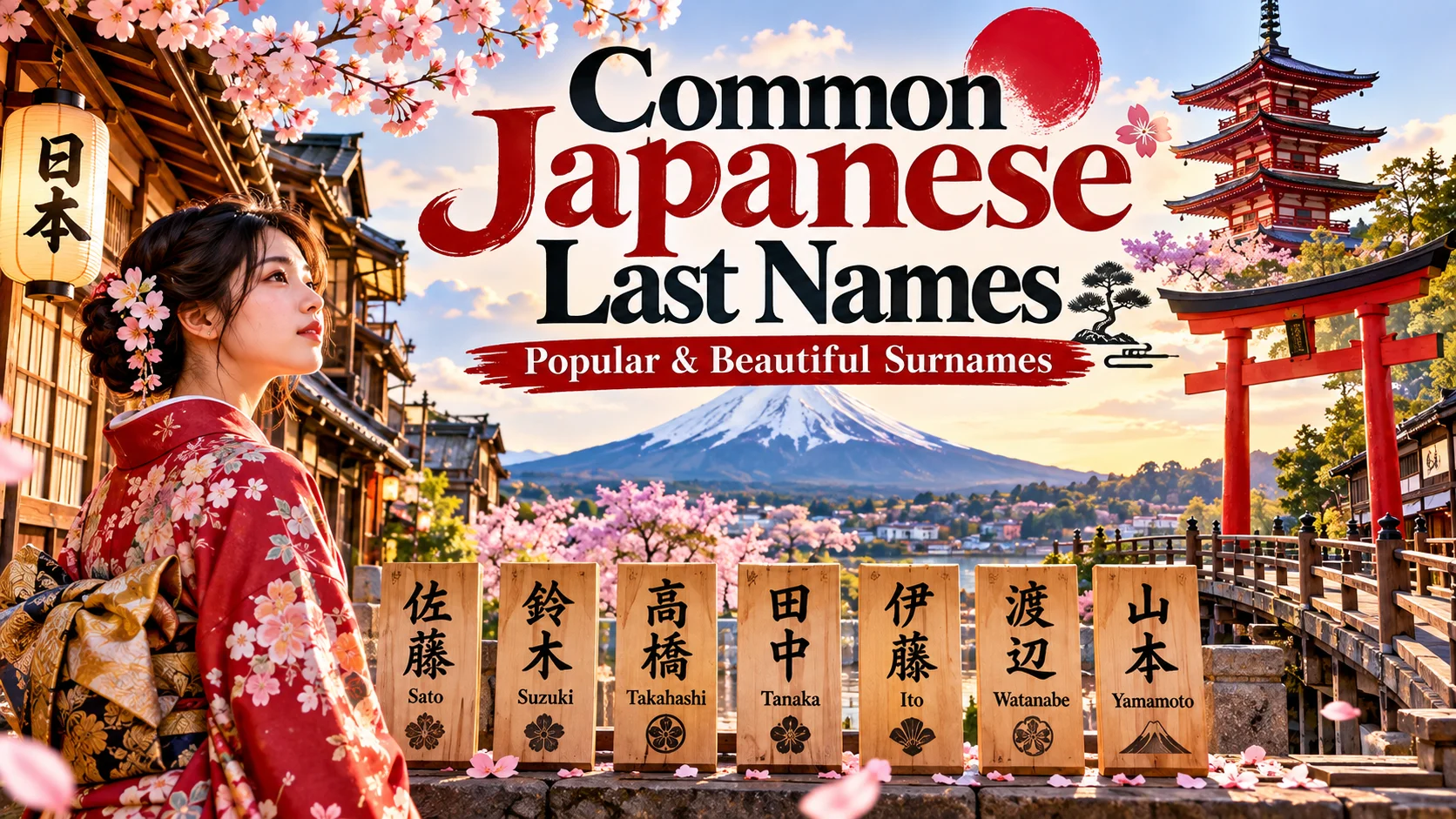
Common Japanese last names offer a fascinating mix of history, culture, nature, geography, and family heritage. If you are searching for common Japanese last names, familiar choices include Sato, Suzuki, Takahashi, Tanaka, Ito, Watanabe, Yamamoto, Nakamura, Kobayashi, and Kato. Current nationwide surname data places these names among Japan’s most widespread family names.
Japanese surnames are especially interesting because they are usually connected to kanji characters and may have several written or historical forms. Many family names developed from places, landscapes, occupations, clans, and local communities. Historical research also shows that Japan’s surname system changed significantly over time, with family names becoming legally required for the population during the Meiji period.
Whether you need popular Japanese surnames for a character, story, username, genealogy project, baby-name research, or cultural study, this guide gives you a wide range of choices. You will find common Japanese family names, traditional surnames, beautiful Japanese last names, short surnames, nature-inspired choices, anime-friendly surnames, and Japanese names with a classic sound.
The article also answers popular long-tail questions such as what are the most common Japanese last names, what are Japanese surnames and their meanings, what are popular Japanese last names, and what Japanese last names are good for characters. So, keep reading to find a surname that fits your exact purpose.
🇯🇵 What Are the Most Common Japanese Last Names?
The most common Japanese surnames include Sato, Suzuki, Takahashi, Tanaka, Ito, Watanabe, Yamamoto, Nakamura, Kobayashi, and Kato.
Current Japanese surname data lists Sato at number one nationally, followed by Suzuki and Takahashi.
🌸 Common Japanese Last Names Used Across Japan
These are some of the most recognizable Japanese family names found in nationwide surname rankings.
They are useful when you need common Japanese surnames, realistic Japanese family names, or familiar names for fictional characters.
- Sato
- Suzuki
- Takahashi
- Tanaka
- Ito
- Watanabe
- Yamamoto
- Nakamura
- Kobayashi
- Kato
- Yoshida
- Yamada
- Sasaki
- Yamaguchi
- Matsumoto
- Inoue
- Kimura
- Hayashi
- Saito
- Shimizu
- Yamazaki
- Mori
- Abe
- Ikeda
- Hashimoto
- Maeda
- Fujita
- Ogawa
- Okada
- Goto
- Hasegawa
- Murakami
- Kondo
- Ishii
- Sakamoto
- Endo
- Aoki
- Fujii
- Nishimura
- Fukuda
- Ota
- Miura
- Fujiwara
- Okamoto
- Matsuda
- Nakajima
- Nakano
- Harada
- Kaneko
- Takeda
- Ueda
- Kawai
- Otsuka
- Sugiyama
- Sugawara
- Kinoshita
- Noguchi
- Imai
- Kikuchi
- Chiba
- Sakai
- Koyama
- Nishida
- Hirano
- Kojima
- Nakayama
- Omori
- Kuroda
- Nomura
- Shibata
- Arai
- Ando
- Hattori
- Oshima
- Kawamura
- Morimoto
- Hirata
- Kawaguchi
- Takagi
- Oda
🎌 Popular Japanese Surnames People Recognize Easily
Popular Japanese surnames often appear in everyday life, media, literature, and fictional settings.
This collection targets searches for popular Japanese last names, familiar Japanese surnames, and widely recognized family names.
- Mizuno
- Takano
- Takashima
- Takamura
- Takahata
- Takeuchi
- Tanimoto
- Taniguchi
- Tashiro
- Tsuji
- Tsuchiya
- Ueno
- Uemura
- Uehara
- Usui
- Uno
- Wada
- Wakabayashi
- Yagi
- Yajima
- Yamanaka
- Yamashita
- Yanagisawa
- Yanagida
- Yanagawa
- Yano
- Yasuda
- Yoshikawa
- Yoshimura
- Yoshino
- Yoshioka
- Arakawa
- Araki
- Asano
- Asai
- Asakura
- Aoyama
- Akiyama
- Akimoto
- Amemiya
- Amaya
- Azuma
- Baba
- Ban
- Beppu
- Bessho
- Chinen
- Doi
- Eguchi
- Enomoto
- Fujimoto
- Fujisawa
- Fujimori
- Furukawa
- Furuta
- Haga
- Hara
- Hino
- Hirai
- Hirakawa
- Ishizaki
- Ishibashi
- Ishihara
- Iwasaki
- Iwata
- Iwaki
- Iwama
- Iwamoto
- Iwabuchi
- Igarashi
- Inaba
- Inagaki
- Kamata
- Kamimura
- Kamiyama
- Kanazawa
- Kanda
- Kanno
- Kawabata
- Kawahara
- Kawakami
🏯 Traditional Japanese Last Names With Historical Appeal
Traditional Japanese surnames can add depth to historical fiction and cultural storytelling.
These traditional Japanese family names include famous historical surnames alongside established Japanese surnames.
- Fujiwara
- Minamoto
- Taira
- Tachibana
- Sugawara
- Ono
- Kiyohara
- Nakahara
- Sakanoue
- Kamo
- Nitta
- Wakiya
- Takeda
- Uesugi
- Shimazu
- Date
- Oda
- Tokugawa
- Hojo
- Sanada
- Imagawa
- Asai
- Asakura
- Akechi
- Matsudaira
- Kuroda
- Nabeshima
- Chosokabe
- Otomo
- Hosokawa
- Kikkawa
- Kobayakawa
- Amago
- Satake
- Mogami
- Naito
- Niwa
- Honda
- Sakakibara
- Okudaira
- Toda
- Ii
- Arima
- Fukushima
- Hatakeyama
- Shiba
- Ashikaga
- Hatano
- Rokkaku
- Urakami
- Akamatsu
- Miyoshi
- Ouchi
- Sue
- Mouri
- Ukita
- Ryuzoji
- Sagara
- Sogo
- Matsunaga
- Kono
- Kuki
- Inaba
- Toki
- Saito
- Hori
- Inoue
- Ando
- Sakai
- Maeda
- Ikeda
- Mori
- Hattori
- Kato
- Ito
- Ogasawara
- Matsudaira
- Hosokawa
- Kurokawa
- Takeda
🍃 Japanese Last Names Inspired by Nature
Nature-inspired surnames are especially interesting because Japanese family names often connect with geographical features and local landscapes.
If you are searching for Japanese last names that mean nature, these names offer associations with mountains, rivers, trees, fields, water, and flowers.
- Aoyama
- Aoki
- Arakawa
- Fujimori
- Fujisawa
- Hayashi
- Hoshino
- Ishikawa
- Iwasaki
- Izumi
- Kawabata
- Kawamura
- Kawano
- Kawaura
- Kawashima
- Kawashita
- Koyama
- Kitayama
- Matsumoto
- Matsubara
- Matsuda
- Matsui
- Matsumura
- Matsunaga
- Matsuzaki
- Mizuno
- Mizutani
- Mori
- Morikawa
- Morishita
- Morita
- Moriyama
- Nakagawa
- Nakayama
- Nishikawa
- Nishiyama
- Ogawa
- Okuyama
- Sakai
- Sakurai
- Sakuraba
- Shimizu
- Shiraishi
- Shiroyama
- Takayama
- Takashima
- Taniguchi
- Tanimoto
- Uemura
- Ueno
- Yamagata
- Yamagishi
- Yamaguchi
- Yamada
- Yamashita
- Yamamoto
- Yamanaka
- Yamazaki
- Hoshikawa
- Hoshizaki
- Tsukamoto
- Tsukada
- Tsukahara
- Tsukishima
- Hanazawa
- Hanamura
- Hanayama
- Ikenaga
- Kameyama
- Kanayama
- Komiyama
- Oikawa
- Ogasawara
- Ayukawa
- Hayakawa
- Kawagoe
- Maekawa
- Maruyama
- Minagawa
- Nagayama
✨ Beautiful Japanese Last Names for Characters
Beautiful Japanese surnames often have a smooth rhythm and visually appealing kanji.
These choices work well for searches such as beautiful Japanese last names, elegant Japanese surnames, and Japanese family names for fictional characters.
- Aihara
- Aizawa
- Amamiya
- Aoyama
- Asakura
- Ayase
- Hanazawa
- Hoshino
- Ichikawa
- Igarashi
- Ishizaki
- Ishihara
- Izumi
- Kamiyama
- Kanzaki
- Kawashima
- Kisaragi
- Mizuno
- Moriyama
- Nishikawa
- Sakurai
- Sakuraba
- Shiraishi
- Tachibana
- Takashima
- Takamori
- Tsukishima
- Uehara
- Yamagata
- Yanagisawa
- Yoshino
- Akizuki
- Akimoto
- Amemiya
- Arisawa
- Asami
- Ayukawa
- Chisato
- Fujisawa
- Fujimori
- Hoshikawa
- Kagawa
- Kanazawa
- Kawano
- Kiryu
- Komatsu
- Kurokawa
- Kurihara
- Matsushita
- Minagawa
- Mizutani
- Morikawa
- Nishino
- Oikawa
- Okazaki
- Sakakibara
- Shibasaki
- Shinohara
- Shiroyama
- Takano
- Takayama
- Tsukamoto
- Ueda
- Ueno
- Wakabayashi
- Yagami
- Yamagishi
- Yamanaka
- Yanagida
- Yano
- Yoshikawa
- Yoshizawa
- Arakawa
- Asano
- Enomoto
- Fujimoto
- Hayakawa
- Hirano
- Imai
- Kanda
- Kawai
- Kitagawa
👨 Japanese Last Names for Male Characters
Japanese surnames are not normally divided into male and female family names.
Still, these Japanese last names for boys, male characters, and Japanese-inspired fictional identities are easy to pair with masculine given names.
- Kurosawa
- Kurosaki
- Kirishima
- Tachibana
- Amamiya
- Hoshino
- Sakuragi
- Sakuraba
- Shinohara
- Kanzaki
- Kagami
- Akizuki
- Tsukishima
- Mizushima
- Fujisaki
- Takamori
- Takamura
- Hayakawa
- Nishikawa
- Kitagawa
- Kamiyama
- Hoshikawa
- Aoyama
- Ichikawa
- Okazaki
- Sugimoto
- Kanazawa
- Matsushita
- Ogasawara
- Nakashima
- Morikawa
- Moriyama
- Uehara
- Kagawa
- Igarashi
- Iwasaki
- Ishikawa
- Ishida
- Ishihara
- Kisaragi
- Hanazawa
- Hanamura
- Amakawa
- Aihara
- Aizawa
- Akiyama
- Akimoto
- Akabane
- Akagi
- Akagawa
- Arisawa
- Asakura
- Chiba
- Chino
- Date
- Enomoto
- Fujino
- Futami
- Hagiwara
- Handa
- Harukawa
- Hasegawa
- Hoshizaki
- Inukai
- Karasawa
- Kasai
- Kasahara
- Kawagoe
- Kawashima
- Kurokawa
- Matsunaga
- Nakashima
- Nishino
- Oikawa
- Okabe
- Okamoto
- Shibasaki
- Takahata
- Takashima
- Yoshizawa
👩 Japanese Last Names for Female Characters
Family names themselves are generally not gender-specific in Japan.
For Japanese girl names with surnames, these choices pair naturally with many feminine given names and work well in stories.
- Mizutani
- Kawashima
- Sakurai
- Tachibana
- Hoshino
- Aoyama
- Fujisawa
- Moriyama
- Hanazawa
- Amamiya
- Kanzaki
- Shiraishi
- Nishino
- Kitagawa
- Tsukishima
- Mizushima
- Kisaragi
- Sakuraba
- Fujisaki
- Ayukawa
- Asakura
- Aihara
- Aizawa
- Arisawa
- Akizuki
- Akimoto
- Amemiya
- Asami
- Chisato
- Enomoto
- Fujimoto
- Hoshikawa
- Kagawa
- Kanazawa
- Kawano
- Kiryu
- Komatsu
- Kurokawa
- Kurihara
- Matsushita
- Minagawa
- Morikawa
- Nishikawa
- Oikawa
- Okazaki
- Sakakibara
- Shibasaki
- Shinohara
- Takano
- Takayama
- Takashima
- Takamori
- Uehara
- Ueno
- Wakabayashi
- Yagami
- Yamagata
- Yamagishi
- Yanagida
- Yanagisawa
- Yoshino
- Yoshikawa
- Yoshizawa
- Hayakawa
- Hirano
- Igarashi
- Iwasaki
- Ishizaki
- Ishihara
- Izumi
- Kamiyama
- Kawabata
- Kawamura
- Kawano
- Mizuno
- Mizutani
- Morishita
- Shiroyama
- Tsukamoto
- Ueda
🎭 Japanese Last Names for Anime and Manga Characters
Anime and manga frequently use familiar Japanese family names alongside less common surnames.
If you need Japanese last names for anime characters, these choices can help create realistic modern or fictional identities.
- Kurosawa
- Kurosaki
- Kirishima
- Tachibana
- Amamiya
- Hoshino
- Sakuragi
- Sakuraba
- Shinohara
- Kanzaki
- Kagami
- Akizuki
- Tsukishima
- Mizushima
- Fujisaki
- Takamori
- Takamura
- Hayakawa
- Nishikawa
- Nishino
- Kitagawa
- Kamiyama
- Kamata
- Hoshikawa
- Aoyama
- Ichikawa
- Okazaki
- Sugimoto
- Kanazawa
- Matsushita
- Ogasawara
- Nakashima
- Morikawa
- Moriyama
- Uehara
- Kagawa
- Igarashi
- Iwasaki
- Ishikawa
- Ishida
- Ishihara
- Kisaragi
- Hanazawa
- Hanamura
- Amakawa
- Aihara
- Aizawa
- Akiyama
- Akimoto
- Akabane
- Akagi
- Akagawa
- Arisawa
- Asakura
- Chikada
- Chino
- Date
- Enomoto
- Fujino
- Futami
- Hagiwara
- Handa
- Harukawa
- Hasegawa
- Hoshizaki
- Inukai
- Karasawa
- Kasai
- Kasahara
- Kawagoe
- Kawashima
- Kurokawa
- Matsunaga
- Nakano
- Nishimura
- Oikawa
- Okabe
- Shibasaki
- Takahata
- Yoshizawa
💎 Unique Japanese Last Names With an Uncommon Feel
Not every Japanese surname is equally widespread. Japan has a very large surname variety, and surname databases contain many less common family names.
These unique Japanese last names can suit fictional characters when you want something distinctive without abandoning a Japanese naming style.
- Shishido
- Shibasaki
- Shigematsu
- Shigemori
- Shigeno
- Shindou
- Shinjo
- Shinozaki
- Shiotani
- Shirakawa
- Shiraishi
- Shirai
- Shiratori
- Shirosaki
- Shizuki
- Sonoda
- Sotomura
- Suenaga
- Suetsugu
- Sugano
- Sugimoto
- Sumida
- Sumiyama
- Sunaga
- Suzuki
- Tabata
- Tachibana
- Tada
- Taguchi
- Tajima
- Takahama
- Takano
- Takanashi
- Takashima
- Takimoto
- Takizawa
- Tamaki
- Tamura
- Tanabe
- Tanigawa
- Taniguchi
- Tanimura
- Tarumi
- Tateishi
- Terada
- Terashima
- Terauchi
- Toda
- Togashi
- Tokunaga
- Tomita
- Tomizawa
- Toriyama
- Tsuboi
- Tsubouchi
- Tsuda
- Tsugawa
- Tsukada
- Tsukahara
- Tsukamoto
- Tsukino
- Tsunoda
- Uchida
- Udagawa
- Ueno
- Umeda
- Umezawa
- Usami
- Usuda
- Wakamatsu
- Wakabayashi
- Wakita
- Watanabe
- Watase
- Yabe
- Yamagami
- Yamanishi
- Yamashiro
- Yanagi
- Yanagihara
- Yanagimoto
🖤 Cool Japanese Last Names for Fictional Characters
Cool Japanese surnames often combine a memorable sound with recognizable Japanese naming patterns.
These options are useful for cool Japanese last names, game characters, manga identities, and modern fictional personalities.
- Kurosawa
- Kurosaki
- Akabane
- Akagi
- Akizuki
- Amamiya
- Arakawa
- Aoyama
- Asakura
- Ayase
- Fujisaki
- Fujimori
- Hoshino
- Hoshizaki
- Ichikawa
- Igarashi
- Ishikawa
- Ishihara
- Kagami
- Kagawa
- Kamiyama
- Kanzaki
- Karasawa
- Kasahara
- Kawashima
- Kisaragi
- Kirishima
- Kurokawa
- Mizushima
- Morikawa
- Moriyama
- Nakashima
- Nishikawa
- Nishino
- Okazaki
- Sakuraba
- Sakuragi
- Shibasaki
- Shinohara
- Shiraishi
- Shiroyama
- Tachibana
- Takamori
- Takamura
- Takashima
- Takizawa
- Tsukishima
- Uehara
- Yagami
- Yamagishi
- Yamanaka
- Yanagisawa
- Yoshikawa
- Yoshizawa
- Hagiwara
- Handa
- Harukawa
- Hayakawa
- Iwasaki
- Kamata
- Kawagoe
- Kawabata
- Kuroda
- Matsunaga
- Matsushita
- Mizuno
- Ogasawara
- Oikawa
- Shigemori
- Shinozaki
- Shiratori
- Suenaga
- Takizawa
- Takanashi
- Tamaki
- Toriyama
- Tsunoda
- Wakita
- Yamagami
- Yamashiro
🌿 Japanese Family Names Connected With Places and Landscapes
Many Japanese surnames developed from geographical locations and natural features.
This makes landscape-based names especially useful for searches about Japanese surnames based on nature, place-inspired family names, and Japanese surname meanings.
- Yamamoto
- Yamaguchi
- Yamashita
- Yamada
- Yamanaka
- Yamagata
- Yamagishi
- Yamashiro
- Takayama
- Nishiyama
- Kitayama
- Higashiyama
- Minamiyama
- Kawaguchi
- Kawamura
- Kawashima
- Kawano
- Kawahara
- Kawakami
- Kawabata
- Kawashita
- Nakagawa
- Oikawa
- Arakawa
- Hayakawa
- Ishikawa
- Ogawa
- Mizuno
- Mizutani
- Shimizu
- Izumi
- Matsumoto
- Matsubara
- Matsuyama
- Matsuda
- Matsui
- Matsumura
- Matsuzaki
- Moriyama
- Morikawa
- Morishita
- Mori
- Hayashi
- Kinoshita
- Fujimoto
- Fujimori
- Fujisawa
- Fujita
- Hoshino
- Hoshikawa
- Hoshizaki
- Tsukamoto
- Tsukada
- Tsukahara
- Tsukishima
- Kanayama
- Kameyama
- Komiyama
- Nagayama
- Maruyama
- Maeyama
- Nishikawa
- Nishino
- Nishida
- Nishimura
- Uehara
- Ueda
- Ueno
- Okuyama
- Kitagawa
- Kitamura
- Minagawa
- Aoyama
- Shiroyama
- Hanazawa
- Hanamura
- Tanigawa
- Taniguchi
- Tanimura
📚 Japanese Last Names and Their Meanings
Japanese surnames can contain kanji associated with places, landscapes, trees, water, mountains, fields, and other features.
If you are researching Japanese last names and their meanings, it is important to check the exact kanji because the same romanized surname can have different written forms.
- Sato
- Suzuki
- Takahashi
- Tanaka
- Ito
- Watanabe
- Yamamoto
- Nakamura
- Kobayashi
- Kato
- Yoshida
- Yamada
- Sasaki
- Yamaguchi
- Matsumoto
- Inoue
- Kimura
- Hayashi
- Saito
- Shimizu
- Yamazaki
- Mori
- Abe
- Ikeda
- Hashimoto
- Maeda
- Fujita
- Ogawa
- Okada
- Goto
- Hasegawa
- Murakami
- Kondo
- Ishii
- Sakamoto
- Endo
- Aoki
- Fujii
- Nishimura
- Fukuda
- Ota
- Miura
- Okamoto
- Matsuda
- Nakajima
- Nakano
- Harada
- Kaneko
- Ueda
- Kawai
- Otsuka
- Sugiyama
- Kinoshita
- Noguchi
- Imai
- Kikuchi
- Chiba
- Sakai
- Koyama
- Nishida
- Hirano
- Kojima
- Nakayama
- Omori
- Kuroda
- Nomura
- Shibata
- Arai
- Ando
- Hattori
- Oshima
- Kawamura
- Morimoto
- Hirata
- Kawaguchi
- Takagi
- Tamura
- Uchida
- Yokoyama
- Ishida
🔤 Japanese Last Names With Easy English Spellings
If you are writing for an English-speaking audience, shorter romanized surnames can be easier to read and remember.
These choices are useful for searches like easy Japanese last names, Japanese surnames in English, and simple Japanese family names.
- Abe
- Aoki
- Arai
- Asai
- Doi
- Hara
- Hori
- Iida
- Imai
- Ito
- Kato
- Kido
- Kishi
- Koga
- Kubo
- Kudo
- Mano
- Mori
- Noda
- Oda
- Oe
- Ogi
- Oka
- Ono
- Ota
- Sano
- Seki
- Seta
- Suda
- Tada
- Taki
- Tani
- Toda
- Toma
- Uda
- Ueno
- Uno
- Wada
- Yagi
- Yano
- Yui
- Yusa
- Bando
- Bito
- Eda
- Egawa
- Eno
- Hama
- Hata
- Hino
- Iba
- Iga
- Kaji
- Kame
- Kani
- Kida
- Kiku
- Koda
- Koma
- Kono
- Maki
- Mita
- Muto
- Naka
- Nishi
- Oishi
- Suma
- Taka
- Tera
- Uchi
- Ume
- Yama
- Yata
- Ise
- Miki
- Nishi
- Sato
- Tani
🌏 Japanese Last Names by Regional and Local Feel
Japan’s surname patterns can vary by prefecture and region.
This is useful when searching for Japanese last names by region, regional Japanese surnames, or family names common in specific parts of Japan.
- Shibata
- Kinoshita
- Noguchi
- Matsuzaki
- Kawai
- Sugimoto
- Nakagawa
- Kawamura
- Hirata
- Takagi
- Morita
- Okamoto
- Nakanishi
- Nishikawa
- Nishio
- Nishida
- Nishiyama
- Noda
- Noma
- Nogami
- Horiguchi
- Horiuchi
- Hoshikawa
- Hoshizaki
- Inaba
- Kageyama
- Kajiwara
- Kamei
- Kanno
- Karasawa
- Kasahara
- Kasai
- Kawabe
- Kawagoe
- Kawahara
- Kawakami
- Kawano
- Kikuchi
- Kitajima
- Kitamura
- Komatsu
- Komori
- Konno
- Kurita
- Kuriyama
- Kuwabara
- Maekawa
- Makino
- Maruyama
- Miki
- Miyagawa
- Miyamoto
- Miyazaki
- Miyake
- Miyashita
- Miyata
- Nagai
- Nagano
- Nagata
- Nagase
- Nakada
- Narita
- Oba
- Ochi
- Ogata
- Oikawa
- Okabe
- Okada
- Okamoto
- Senda
- Sekiguchi
- Shimizu
- Shinohara
- Sugawara
- Takanashi
- Tanabe
- Tanigawa
- Tsuboi
- Tsuda
- Umeda
- Wakamatsu
📖 How Did Common Japanese Last Names Develop?
Japanese family names have a long history. Historical research describes several stages of Japanese naming, including ancient clan names, regional family names, samurai-era naming practices, and the development of modern surnames. Many surnames were connected with places, occupations, natural features, or established family groups.
A major change occurred during the Meiji period. In 1875, the government required Japanese commoners to use family names, helping establish the modern nationwide surname system. This historical development helps explain why Japan has such a large variety of surnames today.
🈶 Why Do Japanese Surnames Have Different Kanji?
Japanese surnames are normally written using kanji, and kanji can carry meaning as well as sound. Because of this, two surnames that look or sound similar in romanization may have different written forms.
This also means that translating a surname into English does not always capture its complete history. For accurate research, check the original Japanese characters and the specific family-name record rather than relying only on an English translation.
✍️ How Are Japanese First and Last Names Written?
Japanese traditionally places the family name before the given name. For example, a person named Tanaka Haruto would have Tanaka as the family name and Haruto as the given name.
Japan’s Ministry of Foreign Affairs has supported the use of the Japanese surname-first order when Japanese names are written in the English alphabet. However, international English-language usage has historically used both orders.
🎎 Are Japanese Last Names Different for Men and Women?
Japanese family names are generally not divided into male and female categories. A family surname can be used by people of different genders, so a surname should not be selected based on whether a character is male or female.
When creating a fictional name, the given name usually creates more of the gender impression. The surname can then be chosen according to realism, sound, regional setting, historical period, or personal preference.
🔎 How Do You Choose a Japanese Last Name for a Character?
Start with the character’s setting and personality. A very common surname can make a modern character feel realistic, while a less familiar surname can help distinguish a fictional character.
Next, check the Japanese spelling. This step matters because romanized Japanese surnames can hide differences in kanji. Also consider the complete name rather than choosing a surname in isolation.
For more English vocabulary, grammar, and naming content, you can explore Mornetic as an internal resource.
❓ Frequently Asked Questions About Common Japanese Last Names
What is the most common Japanese last name?
Sato is currently ranked as Japan’s most populous surname in the nationwide surname data published by Myoji-Yurai. Suzuki, Takahashi, and Tanaka also rank among the most common names.
What are the top 10 Japanese last names?
The current nationwide ranking lists Sato, Suzuki, Takahashi, Tanaka, Ito, Watanabe, Yamamoto, Nakamura, Kobayashi, and Kato among the top ten.
What are some common Japanese last names?
Some widely recognized examples include Sato, Suzuki, Tanaka, Takahashi, Ito, Watanabe, Yamamoto, Nakamura, Kobayashi, Yoshida, and Yamada. These surnames appear prominently in nationwide surname data.
What are Japanese surnames and their meanings?
Japanese surnames often contain kanji connected with places, nature, geography, occupations, or family history. However, the exact meaning can depend on the specific kanji used.
What Japanese last names are common in Japan?
Sato, Suzuki, Takahashi, Tanaka, Ito, Watanabe, Yamamoto, Nakamura, Kobayashi, and Kato are among the most common nationwide surnames in current data. Regional rankings can differ from the national list.
What are good Japanese last names for characters?
Tanaka, Sato, Suzuki, Takahashi, Yamamoto, Nakamura, Aoyama, Hoshino, Tachibana, Sakurai, and Kurosawa can work well for fictional characters. The best choice depends on the character’s setting and style.
What are beautiful Japanese last names?
Names such as Tachibana, Hoshino, Aoyama, Sakurai, Mizuno, Shiraishi, Amamiya, and Fujisawa are often attractive choices for fictional naming because of their sound and visual appeal.
Do Japanese last names have meanings?
Many Japanese surnames contain kanji with literal meanings or geographical associations. Still, the complete historical origin of a family name may be more complicated than a simple word-for-word translation.
Do Japanese people put the last name first?
Traditional Japanese name order places the family name before the given name. Japan’s Ministry of Foreign Affairs has discussed and promoted surname-first ordering for Japanese names in Roman letters.
Are Japanese surnames gender-neutral?
Yes. Japanese family names are generally shared by family members regardless of gender. The given name usually provides more information about gender.
Why are there so many Japanese surnames?
Japanese surnames developed from many sources, including geographic locations, natural features, occupations, clans, and local communities. Historical changes also contributed to the large variety of Japanese family names.
What is a good Japanese surname for an anime character?
A surname such as Kurosawa, Tachibana, Hoshino, Amamiya, Sakurai, Kanzaki, or Kirishima can suit an anime-inspired character. For realism, consider the character’s age, setting, and complete Japanese name.
What is the difference between a Japanese last name and a Japanese family name?
In everyday English, these terms generally refer to the same part of a person’s name. Japanese commonly uses terms such as 名字 or 苗字 for family names, with 氏 also used in legal contexts.
📝 Conclusion
Common Japanese last names reflect much more than a simple family label. They connect language, geography, history, culture, and family heritage. Names such as Sato, Suzuki, Takahashi, Tanaka, Ito, and Watanabe are especially widespread, while thousands of other Japanese surnames provide regional and stylistic variety. Whether you need a surname for a fictional character, anime story, genealogy project, username, or cultural research, always consider the Japanese spelling and context. A romanized surname can hide important differences in kanji, so checking the original form adds accuracy. With so many choices available, you can easily find a Japanese family name that feels natural, memorable, and suitable for your purpose.

Michael Harris is a content writer at NamelyHub, where he shares creative and unique name ideas for every purpose. With a strong interest in branding and modern naming trends, he creates helpful collections of names for pets, teams, businesses, and more.
His goal is to make finding the perfect name simple, inspiring, and accessible for everyone.