
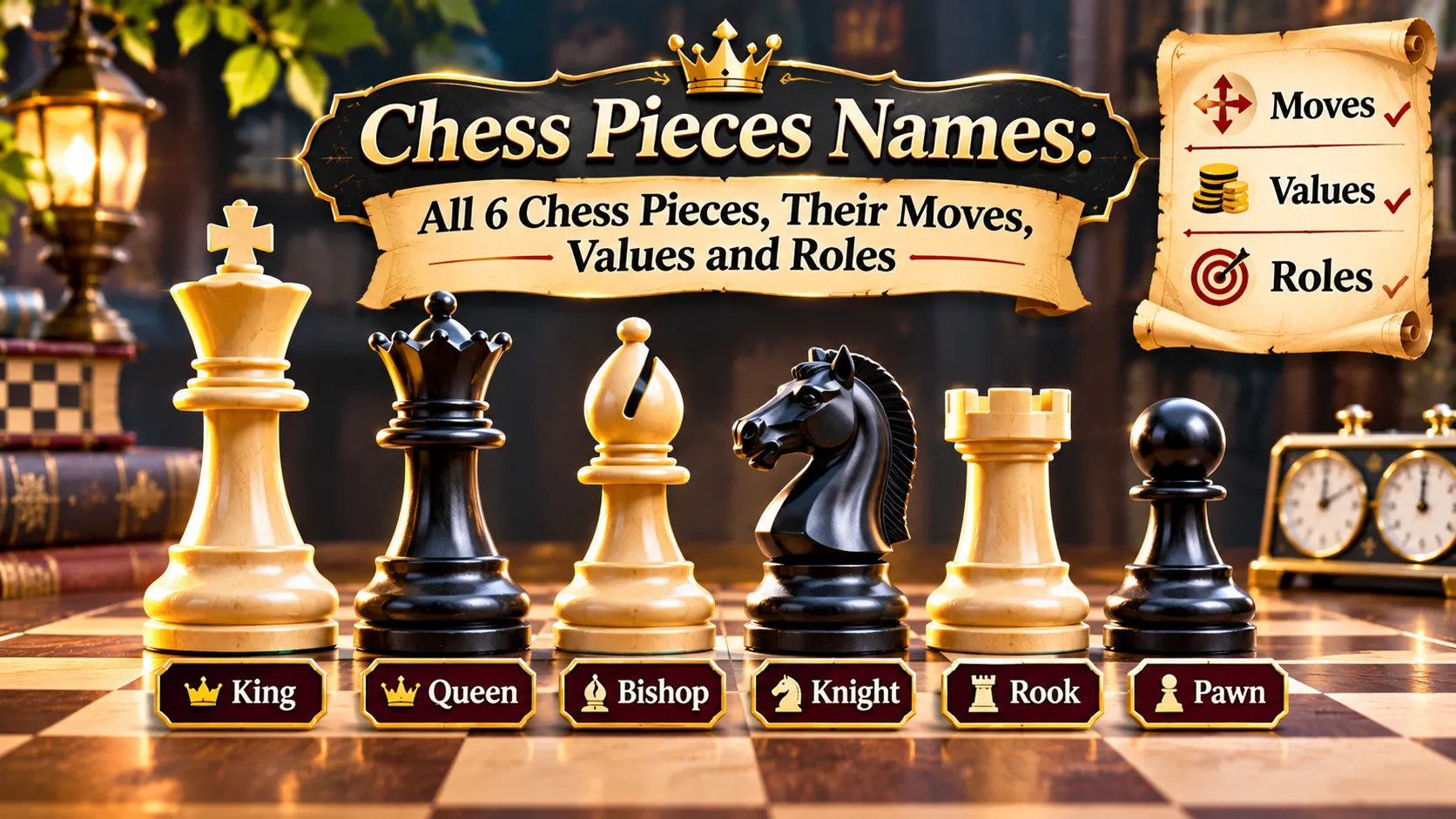
Chess pieces names are essential to understanding how the game works. Whether you’re learning chess for the first time, teaching someone else, or improving your strategy, knowing the names and movements of every chess piece makes the game much easier to follow. Each piece has a different role, movement pattern, and strategic value that influences how you play.
A standard chess set contains 32 pieces divided equally between White and Black. Each player starts with 16 pieces, including one king, one queen, two rooks, two bishops, two knights, and eight pawns. Although people commonly refer to all of them as chess pieces, pawns are sometimes distinguished from the six types of pieces because of their different roles and value.
In this guide, you’ll learn all six chess pieces names, their functions, how they move, and how much each one is generally worth. You’ll also discover their symbols, starting positions, common nicknames, and important differences. Whether you’re interested in chess piece names for beginners or want to understand the game more deeply, this complete guide covers everything you need to know.
♟️ What Are the Names of All Chess Pieces?
There are six different types of chess pieces: king, queen, rook, bishop, knight, and pawn. Each player begins with the same arrangement, giving both sides equal opportunities at the start of the game.
Here are all the chess pieces names:
- King: The most important piece in chess. Protecting your king is the main objective.
- Queen: The most powerful piece, combining the movement abilities of a rook and bishop.
- Rook: A powerful piece that moves horizontally and vertically.
- Bishop: A diagonal-moving piece that controls squares of the same color throughout the game.
- Knight: A unique piece that moves in an L-shaped pattern and can jump over other pieces.
- Pawn: The smallest and most numerous chess unit, usually moving forward one square at a time.
Each player starts with 16 chessmen:
- 1 King
- 1 Queen
- 2 Rooks
- 2 Bishops
- 2 Knights
- 8 Pawns
The complete chessboard contains 32 pieces when the game begins, with 16 White and 16 Black pieces.
👑 King: The Most Important Chess Piece
The king is the most important chess piece because the entire game revolves around protecting it. Although it can move only one square at a time, its safety determines whether you win, lose, or draw. When an opponent attacks your king, the position is called check.
How the king moves:
- Moves one square in any direction.
- Can move horizontally, vertically, or diagonally.
- Cannot move onto a square occupied by one of its own pieces.
- Cannot move onto a square attacked by an opponent’s piece.
- Can participate in a special move called castling when the requirements are met.
King’s symbol: K
King’s approximate value: The king has no ordinary numerical value because losing it means losing the game. Some teaching systems assign it an unlimited or special value.
Starting position:
- White king starts on e1.
- Black king starts on e8.
The king is not the strongest attacking piece, but it becomes increasingly important as the game progresses. During the opening and middlegame, players usually protect it by castling and keeping it away from dangerous attacks. In the endgame, the king often becomes an active piece that helps support pawns and attack the opponent.
👸 Queen: The Most Powerful Chess Piece
The queen is generally considered the most powerful chess piece because it combines the movement abilities of a rook and a bishop. It can travel across the board in straight lines, making it extremely useful for attacking, defending, and controlling important squares.
How the queen moves:
- Moves any number of squares horizontally.
- Moves any number of squares vertically.
- Moves any number of squares diagonally.
- Cannot jump over other pieces.
- Captures an opponent’s piece by moving onto its square.
Queen’s symbol: Q
Queen’s approximate value: 9 points.
Starting position:
- White queen starts on d1.
- Black queen starts on d8.
A queen can attack from long distances and create powerful threats against the opponent’s king. However, bringing it into the game too early can expose it to attacks from less valuable pieces. Good players develop their minor pieces and control the center before committing their queen to an aggressive position.
An easy way to remember its movement is that the queen combines the rook’s straight-line movement with the bishop’s diagonal movement.
🏰 Rook: The Straight-Line Chess Piece
The rook is a powerful chess piece that moves horizontally and vertically across the board. Each player begins with two rooks, which usually start in the corners. Rooks become especially valuable in open positions and endgames where they can control files and ranks.
How the rook moves:
- Moves horizontally across any number of empty squares.
- Moves vertically across any number of empty squares.
- Cannot move diagonally.
- Cannot jump over other pieces.
- Captures an opponent’s piece by landing on its square.
Rook’s symbol: R
Rook’s approximate value: 5 points.
Starting position:
- White rooks start on a1 and h1.
- Black rooks start on a8 and h8.
Rooks are especially effective on open files, where no pawns block their movement. They can also work together to attack an opponent’s king or support passed pawns during the endgame.
Rooks participate in castling, a special move involving the king. During castling, the king moves two squares toward a rook, and that rook moves to the square next to the king on the opposite side.
⛪ Bishop: The Diagonal-Moving Chess Piece
The bishop is a minor chess piece that moves diagonally across the board. Each player starts with two bishops, and each bishop remains on the same color squares throughout the game. One bishop travels only on light squares, while the other travels only on dark squares.
How the bishop moves:
- Moves diagonally in any direction.
- Can travel across multiple empty squares.
- Cannot move horizontally or vertically.
- Cannot jump over other pieces.
- Captures an opponent’s piece by landing on its square.
Bishop’s symbol: B
Bishop’s approximate value: 3 points.
Starting position:
- White bishops start on c1 and f1.
- Black bishops start on c8 and f8.
Bishops are especially useful when the board is open because they can control long diagonals. They work well together because one covers light squares while the other covers dark squares.
A pair of bishops can become particularly powerful in positions with fewer pawns and fewer obstacles. Players often try to preserve both bishops when the position allows them to work together effectively.
🐴 Knight: The L-Shaped Chess Piece
The knight is one of the most unusual chess pieces because it moves in an L-shaped pattern and can jump over other pieces. This special ability makes it valuable in crowded positions where bishops, rooks, and queens may have limited movement.
How the knight moves:
- Moves two squares in one direction and then one square sideways.
- Can move one square in one direction and then two squares perpendicular to it.
- Can jump over friendly and enemy pieces.
- Captures an opponent’s piece by landing on its square.
- Can move to a maximum of eight different squares from a central position on an empty board.
Knight’s symbol: N
Knight’s approximate value: 3 points.
Starting position:
- White knights start on b1 and g1.
- Black knights start on b8 and g8.
The knight’s movement can be difficult for beginners because it does not follow a straight line. A helpful way to remember it is to imagine drawing the letter L on the chessboard.
Knights are often strong in closed positions because they can jump over pawns and other pieces. They can also create forks, attacking two or more enemy pieces at the same time.
♙ Pawn: The Smallest Chess Piece
The pawn is the smallest and most numerous chess unit on the board. Each player begins with eight pawns, which form the front line of the starting position. Although pawns have limited movement, they are essential for controlling the center, protecting important squares, and creating promotion opportunities.
How the pawn moves:
- Normally moves forward one square.
- Can move forward two squares from its starting position if both squares are clear.
- Captures diagonally forward by one square.
- Cannot move backward.
- Can promote when it reaches the opposite end of the board.
- Can capture through a special move called en passant when the conditions are met.
Pawn’s symbol: P
Pawn’s approximate value: 1 point.
Starting position:
- White pawns occupy the second rank, from a2 to h2.
- Black pawns occupy the seventh rank, from a7 to h7.
Pawns may look weak compared with the other chess pieces, but they play a major role in controlling space and creating strategic opportunities. A well-supported pawn structure can restrict an opponent’s movement and protect important pieces.
When a pawn reaches the opposite side of the board, it can be promoted to a queen, rook, bishop, or knight. Most players choose a queen because it is generally the most powerful option.
📊 Chess Pieces Names and Their Point Values
Chess piece values help beginners understand the relative strength of different pieces. These numbers are commonly used as a guide when deciding whether a capture or exchange is worthwhile.
| Chess piece | Symbol | Approximate value |
|---|---|---|
| King | K | Priceless |
| Queen | Q | 9 points |
| Rook | R | 5 points |
| Bishop | B | 3 points |
| Knight | N | 3 points |
| Pawn | P | 1 point |
These values are not official rules. They are general teaching guidelines that help players compare pieces and understand material advantages.
For example:
- A queen is usually worth more than a rook.
- A rook is generally worth more than a bishop or knight.
- Bishops and knights are often considered approximately equal in value.
- A pawn is worth less than the other pieces, but it can become a queen through promotion.
- The king cannot be traded or captured because its safety determines the result of the game.
Actual piece value depends on the position. A well-placed knight may be more useful than a poorly positioned bishop, while an active rook can be more valuable than a passive rook.
🧩 Chess Pieces Names and Symbols
Every chess piece has a standard letter used in chess notation. These letters help players record moves, study games, and understand written chess instructions.
Here are the common English notation symbols:
- K – King: Used to represent the king.
- Q – Queen: Used to represent the queen.
- R – Rook: Used to represent the rook.
- B – Bishop: Used to represent the bishop.
- N – Knight: Used to represent the knight.
- P – Pawn: Used in some instructional and descriptive contexts, but not written as a letter in standard algebraic move notation.
In standard algebraic notation, a pawn move is written using its destination square without a piece letter. For example, e4 represents a pawn moving to e4.
The knight uses N instead of K because K is already reserved for the king.
♟️ Chess Pieces Names in White and Black
A standard chess set has two colors: White and Black. Each player controls 16 pieces, and both sides begin with the same types and number of pieces.
White chess pieces:
- White King
- White Queen
- Two White Rooks
- Two White Bishops
- Two White Knights
- Eight White Pawns
Black chess pieces:
- Black King
- Black Queen
- Two Black Rooks
- Two Black Bishops
- Two Black Knights
- Eight Black Pawns
The pieces have the same movement rules regardless of color. White makes the first move, and players then alternate turns throughout the game.
📍 Starting Positions of All Chess Pieces
Knowing where every chess piece starts is one of the first steps toward learning chess. Both players arrange their pieces in the same basic formation, with the major pieces behind the pawns.
White’s starting positions:
- King: e1
- Queen: d1
- Rooks: a1 and h1
- Bishops: c1 and f1
- Knights: b1 and g1
- Pawns: a2, b2, c2, d2, e2, f2, g2, and h2
Black’s starting positions:
- King: e8
- Queen: d8
- Rooks: a8 and h8
- Bishops: c8 and f8
- Knights: b8 and g8
- Pawns: a7, b7, c7, d7, e7, f7, g7, and h7
An easy rule helps beginners remember the queen’s starting square: the white queen starts on a light square, and the black queen starts on a dark square. The kings occupy the remaining central squares.
⚔️ Which Chess Piece Is the Strongest?
The queen is generally considered the strongest chess piece because it can move horizontally, vertically, and diagonally across the board. Its wide movement range allows it to attack and defend from many different positions.
However, the king is the most important piece because the game ends when a player is checkmated. The king cannot be captured like an ordinary piece, and protecting it is the central objective of chess.
A simple comparison looks like this:
- Queen: Strongest in general attacking and movement ability.
- Rook: Powerful on open files and ranks.
- Bishop: Strong at controlling long diagonals.
- Knight: Valuable for jumping over pieces and creating forks.
- Pawn: Important for controlling space and promoting.
- King: Most important because its safety determines the game’s outcome.
The strongest piece is not always the most useful piece in every position. Good chess strategy depends on how effectively you use each piece with the others.
🧠 What Are the Different Roles of Chess Pieces?
Every chess piece has a specific role, and understanding these responsibilities helps you develop better strategies. Some pieces control long distances, while others protect the king, attack weak squares, or create opportunities for promotion.
- King: Protects itself from checkmate and becomes active in the endgame.
- Queen: Creates powerful attacks and supports defensive operations.
- Rook: Controls open files, ranks, and important lines.
- Bishop: Controls diagonals and attacks from a distance.
- Knight: Attacks nearby squares, jumps over obstacles, and creates forks.
- Pawn: Controls space, supports other pieces, blocks attacks, and can promote.
Successful chess players do not simply move pieces wherever they can. They coordinate their pieces so that each one supports the overall plan.
🔄 Special Chess Moves You Should Know
Chess includes a few special moves that beginners should understand. These moves follow specific rules and make the game more interesting.
Castling
Castling is a special move involving the king and one rook. It allows the king to move two squares toward the rook while the rook moves to the square next to the king.
- The king and selected rook must not have moved previously.
- The squares between them must be empty.
- The king cannot currently be in check.
- The king cannot pass through or land on an attacked square.
En Passant
En passant is a special pawn capture that can happen immediately after an opponent moves a pawn forward two squares from its starting position.
- The capturing pawn must be on the correct neighboring file and rank.
- The opponent’s pawn must have just moved two squares.
- The capture must be made immediately on the next move.
- The capturing pawn moves diagonally to the square the opponent’s pawn passed over.
Pawn Promotion
Pawn promotion happens when a pawn reaches the opposite end of the chessboard.
- A white pawn promotes on the eighth rank.
- A black pawn promotes on the first rank.
- The pawn can become a queen, rook, bishop, or knight.
- The player chooses the new piece.
- Promotion can give a player an additional queen.
These special moves are important because they can change the position dramatically and create winning opportunities.
❓ Frequently Asked Questions About Chess Pieces Names
What are the six chess pieces names?
The six chess pieces names are king, queen, rook, bishop, knight, and pawn. Each piece has a different movement pattern and role. Every player starts with one king, one queen, two rooks, two bishops, two knights, and eight pawns.
How many pieces are in a chess set?
A standard chess set contains 32 pieces at the beginning of a game. Each player has 16 pieces, including one king, one queen, two rooks, two bishops, two knights, and eight pawns.
What is the most powerful chess piece?
The queen is generally the most powerful chess piece because it can move any number of squares horizontally, vertically, or diagonally. It combines the movement abilities of a rook and a bishop.
What is the most important chess piece?
The king is the most important chess piece because protecting it is the main objective of the game. If the king is checkmated, the game ends in a loss for that player.
What are the chess pieces worth in points?
The commonly used approximate values are one point for a pawn, three points for a knight, three points for a bishop, five points for a rook, and nine points for a queen. The king has no ordinary point value because it cannot be captured.
Which chess piece can jump over other pieces?
The knight is the only standard chess piece that can jump over other pieces. It moves in an L-shaped pattern, traveling two squares in one direction and one square perpendicular to that direction.
Which chess piece moves diagonally?
The bishop moves diagonally across the chessboard. It can travel any number of empty squares along a diagonal but cannot jump over other pieces.
Which chess pieces move in straight lines?
The rook moves horizontally and vertically, while the queen moves horizontally, vertically, and diagonally. Both can travel across multiple empty squares but cannot jump over other pieces.
Can a pawn become a queen?
Yes. A pawn can become a queen when it reaches the opposite end of the chessboard. This special move is called pawn promotion. A pawn can also promote to a rook, bishop, or knight.
Why does the knight use the letter N instead of K?
The knight uses N in standard chess notation because K is already used for the king. This distinction prevents confusion when recording chess moves.
How many queens can a player have in chess?
A player starts with one queen but can have more than one if a pawn promotes. Since any number of pawns can promote during a game, a player can theoretically have multiple queens at the same time.
Are bishops and knights worth the same points?
Yes. Bishops and knights are both commonly valued at approximately three points. However, their actual usefulness depends on the position, pawn structure, and available squares.
Conclusion
Learning chess pieces names is an important first step toward understanding the game. The six types are the king, queen, rook, bishop, knight, and pawn, and each has its own movement rules and strategic purpose.
The queen is the most powerful piece, the king is the most important, and the rook, bishop, and knight provide different attacking and defensive opportunities. Pawns may be small, but they help control the board and can even become queens through promotion.
Once you understand the names, symbols, starting positions, and movements of all the pieces, you’ll have a stronger foundation for learning chess openings, tactics, and strategies. Practice moving each piece, study how they work together, and enjoy improving your game.

Michael Harris is a content writer at NamelyHub, where he shares creative and unique name ideas for every purpose. With a strong interest in branding and modern naming trends, he creates helpful collections of names for pets, teams, businesses, and more.
His goal is to make finding the perfect name simple, inspiring, and accessible for everyone.